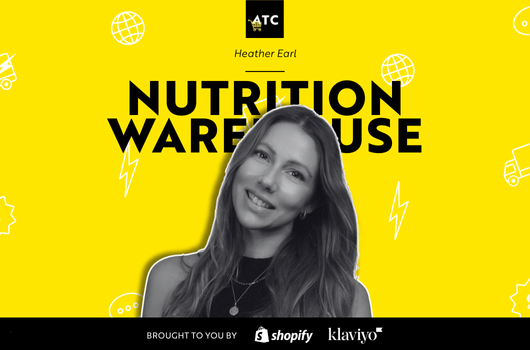
Nathan Bush: When your brand is riding a wave that just keeps growing, you need more than just the right platform. You need the right partner. Gander Clothing was scaling rapidly, but their e commerce tech just couldn't keep up. That's when they partnered with Convert Digital. Since launching a headless Shopify plus site in 2021, they've seen incredible results. A 300% increase in daily orders, 16% revenue growth and a 12% conversion boost. With faster load, seamless checkout experience and powerful omnichannel integration, Gander has transformed into one of Australia's biggest retail success stories. And it's all powered by Convert Digital's commerce expertise. It's commerce that stacks up. Read the full case study@convertdigital.com all right, here we are. Today we are going to share with you the secrets to conquering AI in search engines. Absolutely everything you need to know around how to make sure that your brand shows up in every GPT, every AI search that's ever been invented. Who am I kidding? We can't do that. No one can. It is only early days of AI, and while AI is definitely reshaping what search looks like now and into the future, we are only starting to get a hint of what the possibilities are and what the impact will be on search. And this is from both a brand perspective, how we invest our time and our effort into making sure that we show up organically. But also there's a whole changing customer behavior out there where they're inputting queries that are three times as long as standard search results. The whole world is shifting, but what we wanted to do is bring it back and understand what we know right now because we have had some amazing guests give their insight on what this shift means and what retailers can do today to do their best to make sure that they are set up for AI search. Now, this was all kicked off and inspired by our recent conversation with Heather Earle from Nutrition Warehouse. It was such an amazing conversation. Heather nerded out on a heap of E commerce areas, really getting into the detail and the operations of E commerce, which our listeners loved. I got so much feedback from that episode, but it was her tactics around AI search that really stood out to me. Heather talked about using Shopify's knowledge base. It's an underrated and underused feature of Shopify which effectively teaches LLMs how to shop her store by detailing products, reviews and policies, essentially saying to the LLMs, go over here and look at this, this and this. By doing this, Heather has already helped Nutrition Warehouse achieve a massive 300% increase on ChatGPT driven traffic, albeit off a low base, presumably. But she didn't chase SEO hacks, she focused on training the machine and that's what we want to focus on today before we dive into training the machine for search. Let's throw back to that episode with Heather where she talked us through her process of how she trained the machine using Shopify's Knowledge Base.
Heather Earle: Yeah, they really did. And, and, and yeah, now that it's built out, we can definitely see the impact for sure.
Nathan Bush: That's cool. Are you getting much traffic now from your LLMs?
Heather Earle: Oh yeah, absolutely. We've had a huge increase in our traffic and LLMs we had about. It was over 300% surge in ChatGPT traffic in the last six months.
Nathan Bush: Wow.
Heather Earle: Since Knowledge Base has been doing it, we're seeing gradually every week we can see it. But yeah, finding out exactly what our customers are looking for, being able to use LLMs to find that out, I mean it's quite a simple way of doing it, finding out exactly that. The majority of the searches that lead to conversion on our site are finishing in near me. So they're going, I'm looking for this product or help me with this journey I'm looking for, or I'm trying to get into running, I'm going to need this or what do I need and how do I get this near me? And they all seem to finish in a bit of a near me. And I mean, why wouldn't we be leaning into that? We have 122 stores in Australia, three in New Zealand, with more opening this year and we're not slowing down in the store space. So we do have a store near you. One of our founders goals is to be within 20 kilometers of every Australian. Right. We want to be where our customers are and I mean that feels old school retail to a lot of people, but to us, I think that visibility of the store near the gym, that they've got to get out of the house to go to the gym, it makes a lot of sense and it works for us and it builds that community, it builds that values, it keeps, you know, our customers feeling a part of something as well. But having that near me at the end of our search made me go, gosh. Customers are wanting to shop a store online. So we reworked our collections pages to be able to filtered by store. So you write from a collection level, you can shop the store near you, you can go, hey, I'm in Melbourne City today. If I wanted to go to the Melbourne City Store and I knew I was going to click and collect because I don't have time to go to the store, browse, have a chat with my store staff, my local legend in store that day, it's really being able to go online, filter the collection by Melbourne City, only see the products that are available there. We still do msl, so all our stores have fairly different stock based on what their customers are looking for in that region. And we give that power to our store managers. Both a blessing and a curse, I guess, but from a tech point of view. Curse, but from, you know, a customer point of view, great. So for us, having our collection pages be able to be filtered by stores so that you can shop the Click and Collect part of your journey far earlier on. And a lot of people with Click and Collect have that intention as they're on site at a very early point. So having click and collect happen at checkout, which is what we did have early last year, where the earliest point where you could select click and collect is at checkout and then it goes actually that's not available at the store near you that you actually want to shop from. It's only available online. That really hinders people. So bringing that earlier in the journey at the collection point not only helped us to feel like we were replicating that store experience, but it took away a really big barrier to purchase, a huge drop off point, increased our bounce rates. Yeah, it helped a lot.
Nathan Bush: You're almost giving every physical store their own online store by doing it that way, right?
Heather Earle: We really are. And after those learnings coming back from the LLMs, like leaning more into that, featuring that more heavily, we're reworking our entire store locator, the store landing pages, to help better suit that model.
Nathan Bush: So of course, as we said, this isn't everything that you need to know around showing up in AI search. No one knows that anyone who does tell you that is lying or trying to get your money. But what I love about Heather's approach is that it's setting up the systems for success, even if we need to shift those systems over time by focusing on the systems rather than shifting all of our attention away from search. That has worked for a long time and taking all that effort over many, many years and totally re pivoting over to LLMs and is just setting up the systems quite differently to leverage the work that they've already done for traditional search. And that's the trick here. Large language models don't discover your brand. They interpret what you've got and what you've already told them and how well they interpret what you've got comes down to three fundamentals. Number one, data integrity is non negotiable in this game. Before you can optimize anything, you have to trust your product information, especially if that's what you want your LLMs to get. Abel Butler from Health Post calls it a compliance gateway. He uses it slightly different. He uses product data to verify a supplier. If a supplier can't provide transparent, detailed data, they don't make the range. He needs all of that filled out. What I love about this approach is that he's setting products up not just to have products that he can stand behind ethically, but he's also getting a whole bunch of information beyond the obvious around what customers might be looking at when they're doing those long queries in LLMs. Think about where is this product source? Is this ethically produced? What is it made out of? All those queries that will come up in LLMs that people might not type into traditional search engines or on your search page, you betcha that they will be asked in those LLMs because we expect more. So knowingly or not, what Abel has done by requesting all of this additional information from his suppliers is set himself up to have information that will earn him a place in AI driven search machines can't recommend what they don't understand and he is treating his product data as AI infrastructure. So think about what is important to your customers. What are those situational or lifestyle elements that are going to be really important to them? If we think back to our recent episode with Stacy Head at she Wear, she actually said, hey, these shoes are airport friendly or they're orthodontically approved or they're non slip. All these little factors beyond exactly what it's made for, the sizes, the colors are gonna be so important when it comes to LLM. But first we've gotta feed the machine all that information. Go beyond the obvious with your product data. The second lesson there is to optimize your technical search health. Even the cleanest data won't matter if the machine can't find it. Harry Sanders from Studio Hawk is the SEO guru of all gurus. And he reminds us that SEO, just like GEO or aeo, whatever you like to call it, starts with structure. You still need to run an audit. Use Google Search Console de index, the junk that doesn't add value. It's not about adding more pages. Sometimes it's making sure that the right ones are visible. So when it comes to LLMs, you need to rely on crawlable, trustworthy signals. So go test it. Go jump on all the LLMs, see if you turn up, See where you don't turn up, see where you should turn up. Now, if you're not turning up on the LLMs now, you might need to go back and revisit some of that site structure. That is the same site structure that's available on SEO, but with more of a focus on query fan outs to give the machines a sitemap that actually makes sense. Go test it. And number three, make your data programmatic. Once data is clean and accessible, make it machine consumable. As Eric Su said, the future is APIs all the way down. That means that your pricing, your inventory, your product specs need to be accessible and accessible in real time, not trapped in spreadsheets or siloed platforms. We've seen the future already. We've seen that deal with ChatGPT and Walmart and Shopify and Etsy where people are going to be able to shop within that GPT. So if you haven't got your feeds up to date and firing in real time, how do you expect them to shop within these platforms? It's going to be an expectation very, very soon. So AI tools will always pull from dynamic data sources. If your data is locked or closed behind a platform that isn't accessible, you're going to be invisible when the next generation of chat or voice commerce systems go looking for the answers, and not just the answers for the conversion as well. So while we don't know the full picture on what AI search is going to look like in the future, there are some really clear principles that are starting to build clean data builds trust and go beyond the obvious data. Structured data builds access. Make sure that the machines can see where your data is. And number three, programmatic data builds speed. Make sure your data is in real time and accessible. If you can start getting those three layers right, it's not a diversion from where you've been with SEO, it's building on your SEO strategy to be able to service both SEO and AEO in the future. It's not about abandoning where we've been to go where we're going. It's about continuing to build, but steering towards where the future is going. So I hope that was a nice extension from what Heather was talking about around training the machine with the information that you want to use. Like I said, you could just start with that knowledge base as a starting point and go from there. Because in the new world of AI discovery, visibility isn't about who shouts the loudest. It's about who the machine understands the best. Now, if you enjoyed this playbook or still have a thousand questions like I do, don't we all in this space, make sure you jump on over to the Add to Cart community. It's free and we have over 500 e commerce professionals in there ready to answer your questions and share tips and on how to show up in AI search or whatever topic you like. Head on over to Add to Cart. Com to sign up. As always, if you liked what you heard today, make sure you hit subscribe on YouTube, Spotify, or Apple, wherever you are listening so that we can keep bringing you the best in ecommerce.