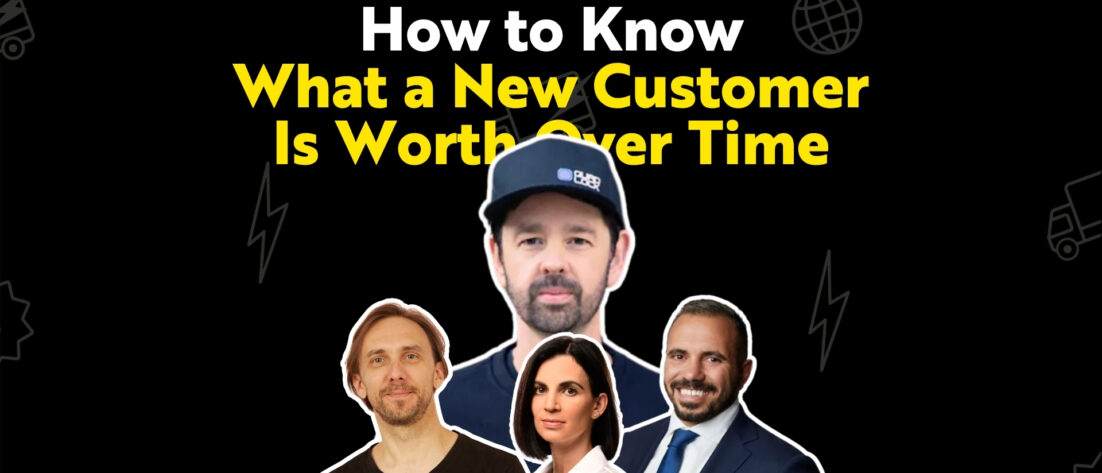

We’re all racing to acquire new customers at the moment. But how do you actually know what a new customer is worth, not just on that first purchase, but over time?
A customer who came in at 30% off is not the same customer as one who paid full price, even though the two can look identical in your reporting. Most of us can say how many new customers we brought in last month. Far fewer can say what that group went on to do, whether they came back, and whether they were worth what we paid to acquire them.
The Three Gates Every New Customer Has to Pass
Rob Ward co-founded Quad Lock, bootstrapping it from a novelty bottle opener into a business doing more than $200 million in revenue and $50 million in EBITDA, before selling it to Swedish outdoor group Thule for $500 million at the end of 2024. He’s since written everything he learned into a free DTC playbook, including a framework for measuring what a new customer is worth. He calls it the three gates.

The way I like to think about it is the three gates. The first gate simply is, are you profitable on first purchase? And the important thing here is you’re not using CAC, you’re using nCAC, just looking at new customers.
Rob Ward, Co-founder, Quad Lock
Gate one is profitability on the first purchase. Gate two is payback: how long it takes to get that money back. Gate three is lifetime value: what the customer is worth across the whole relationship. Not every gate needs to be green. Quad Lock itself would have failed different gates at different times. What the gates give you is somewhere to look.
In this article, we cover three things ecommerce operators can take into their business:
- Split new customers from returning customers before you calculate anything, because a blended number describes nobody
- Watch a real cohort of customers come back rather than assuming they will
- Find the customers actually worth having, then go looking for more of them
Split New From Returning Before You Calculate Anything
Gate one only works on new-customer numbers: nCAC rather than blended acquisition cost, and new-customer average order value rather than a blended one. Map it out and the reason becomes obvious.
Say a blended AOV is $95, but new-customer AOV is $68, because returning customers buy more and trust the brand more. Say blended CAC is $40, but nCAC is $72, because a lot of that spend was retargeting people who’d already bought. At a 45% contribution margin, the blended maths says a brand is $2.75 ahead on every customer. The new-customer maths says it’s $41 down on everyone it brings in. Average the two together and the number describes nobody.
Carla Penn-Kahn, co-founder of ProfitPeak, is more bullish on gate one than Rob is.

Really important to distinguish between new and returning customers. You want to know what are my new customers, how profitable are they. I know a lot of businesses say it’s okay if they’re profitable from order two or three. I really don’t believe that to be the case. They need to be profitable at day one.
Carla Penn-Kahn, Co-founder, ProfitPeak
Rob says a brand can go negative on that first order as long as it can observe customers coming back. Carla says day one, unless it’s a subscription. Neither is wrong, they’re just different ways of managing a business.
Payback Has to Be Observed, Not Hoped For
Gate two is the payback period: how long it takes to earn back what was spent acquiring a customer. Rob’s bands are a good starting point. Back into profit inside about three months is green, seven or eight months is amber, past twelve is red. But those bands are worthless if the return is assumed rather than actually watched happen.
Hold one month of new customers as a cohort and follow it for twelve months, plotting what it’s contributed against what was paid to acquire it. The month the line crosses zero is the payback period. Anything not watched is a forecast.
Danny Chiha, a founding partner at Kelly+Partners, sees these businesses at the point where the maths has already caught up with them.

I’ve seen a guy, he came to us with a 200 grand Facebook debt for ads that weren’t actually at all profitable. I’m like, you’ve got no choice but to liquidate here. There’s no path away from this.
Danny Chiha, Founding Partner, Kelly+Partners
A brand can acquire customers at a rate that looks perfectly good, but if they don’t come back, it’s just accumulating cost. If they don’t come back soon enough, the cash runs out.
Find the Customers Worth Having, Then Go Looking for More
Gate three is lifetime value: working out which customers are actually worth having, then going and finding more of them. Start by describing what a good one looks like: they buy at full price rather than only on offer, they keep what they order, they don’t need a support ticket every time, and they come back without paid media bringing them back.
Then find them in the data. Take customers from six or twelve months ago and split them by what they bought first, which channel they came through, and what offer they came in on. Some of those first purchases reliably produce customers who return. Some produce people who buy once at 40% off and never come back, the same number of new customers on the dashboard, a completely different outcome for the business.
Mark Baartse has spent years as an outsourced chief marketing officer, and this is the work he keeps coming back to.

What you’ll find digging about numbers is a percentage of customers have made one purchase and a percentage have made 20. It’s figuring out who is which, and how you find more of those 20-purchase customers.
Mark Baartse, Founder, Mark Baartse Consulting
Once a brand knows which group behaves the way it wants, that’s its seed group. Instead of uploading every purchaser to Meta for a lookalike, upload only that group. That’s buying more of the good ones instead of more of everyone.
The Takeaway
A new customer isn’t meant to score green across all three gates. Quad Lock failed different gates at different times and still sold for half a billion dollars. Split new from returning before calculating anything, watch a real cohort rather than assuming it will come back, and once the good customers are identified, use them as the seed for the next round of acquisition instead of buying more of everyone.
Frequently Asked Questions
How do you measure what a new customer is worth? Use Rob Ward’s three gates framework: are they profitable on the first purchase using new-customer CAC and AOV, how long until that spend pays back, and what are they worth across the whole relationship. Not every gate needs to be green; the framework is for finding where your levers actually are, not for scoring perfectly.
What is new-customer CAC (nCAC)? New-customer CAC is customer acquisition cost calculated only on new customers, rather than blended across your whole customer base. Blended CAC is usually lower because it includes cheap retargeting spend aimed at people who’ve already bought, which makes new-customer acquisition look more profitable than it actually is.
What is a good payback period for customer acquisition cost? Rob Ward’s bands are a starting point: earning back what you spent within about three months is green, seven to eight months is amber, and past twelve months is fragile. The only way to know your real number is to track a cohort of new customers over twelve months and find the month their contribution crosses zero, not assume it will happen.
How do you find your best customers to target more of them? Split past customers by what they bought first, which channel they came through, and what offer brought them in, then see which combinations reliably produce customers who return at full price. Use that group as a seed audience for lookalike targeting instead of uploading every purchaser, so you’re buying more of the customers actually worth having.
Based on Episode 663 of the Add To Cart podcast with Rob Ward, Co-founder of Quad Lock and creator of The DTC Playbook. Join the Add To Cart community for free.
Join us!
Come behind the scenes with Add To Cart Community: Join our crew of ecommerce operators chasing growth, sharing wins, and staying sharp with deep dives, live events and no-BS inspiration.