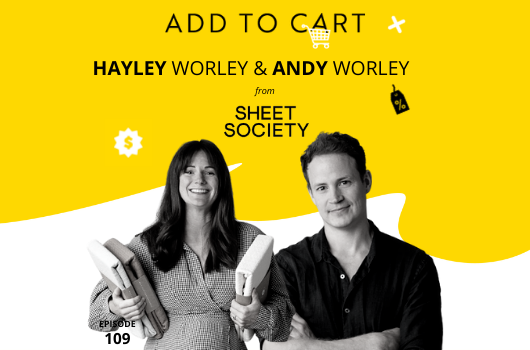
Ed Ovenden: One in four Aussie men age 18 to 35 only wash their bed sheets four times a year.
Bill Ovenden: We do push the boundaries quite a bit, to the point where we have received a cease and desist letter before by some big bedding companies.
Ed Ovenden: It was an eye opener for us. When we sort of left Airly beach, we're like, geez, we've got to lift our game in the bedroom.
[Voiceover]: Welcome to ADD to cart, Australia's leading e commerce podcast that express delivers all you need to know in the fast moving world of online retail. Every week, Nathan Bush from E Suite and E Commerce industry expert will share the news, research and insights that you need to know to keep you at the top of your game. And of course, keep your customers adding to Cart.
Nathan Bush: Hello and welcome to Add to Cart. My name is Nathan Bush, host of Add to Cart and director at e commerce talent agency E Suite. Now strap yourselves in for this one. Today's guest have a business mission which is to help young men lift their game in the bedroom department, but not
Bill Ovenden: in the way that you think you siggos.
Nathan Bush: Bill and Ed Ovenden are brothers who have established the bedroom brand the Lad Collective. Founded in 2020. Ed and Bill have developed bed sheets that even bloody useless Australian males can use. Guilty corner tags, magnetic clips, zips in pillow slips. It is totally idiot proof. But jokes aside, there is actually a serious side to this business which is brilliant. They've developed a version of the product which is registered with the ndis, the National Disability Insurance Scheme, and it even includes braille sewn into the product. In this very entertaining conversation, Ed and Bill share the launch prank that they did in the Brisbane river which got the PR machine pumping and got their business started. We also discuss cease and desist letters, how they screwed up their first pre orders and why Ed has his mobile
Bill Ovenden: number in the website footer. There's some good stuff in there too, I promise.
Nathan Bush: Before we get to today's episode, I want to let you know that enrollments for E Suite's E commerce accelerator are now open. If you're looking to get into E commerce or want to take your career to the next level, come and join in. Classes commence March 22nd and you can sign up now at learn.esweettalent.com all right, let's get into it. Let's see how these guys make men better in the bedroom. Thanks to our partners, Shopify plus and Signet. Here's our conversation with Ed and Bill Ovenden, co founders of the Lad Collective. Ed and Bill, welcome to ADD to Cart.
Ed Ovenden: G', day, Bushy. How are you, mate?
Bill Ovenden: Very well, thank you, Bushy. I like how this has gotten off already. We are away, guys.
Nathan Bush: I've had a look at the Collective online and it's been a few years
Bill Ovenden: since I've been in a share house and that I've been in charge of making my own bed. But tell me that guys don't need help making the bed.
Ed Ovenden: No, in fact, they definitely do, Nathan. And we'll sort of rewind sort of maybe three or four years. When Billy and I lived in a share house up in Airlie beach, we just, you know, ran amuck up there and we just didn't take care of ourselves in the bedroom and neglected that pocket of our life and just, you know, focused on partying, going around the Whitsundays, you know, all that sort of stuff.
Bill Ovenden: But you had better things to do back then.
Ed Ovenden: Yeah, exactly. And that's when we sort of came to a realization that, geez, you know, when you, you know, when you fly the coop and you leave home, you sort of. Your mum's not there to look after you anymore and you sort of. It sort of builds up. So that sort of. That sort of was an eye opener for us. When we sort of left Airlie beach, we're like, geez, we've got to lift our game in the bedroom department. And that's sort of the genesis of the Lard Collective story. Is this our. Yeah, we're just your everyday Aussie bloke who has never bought bedsheets or thought of bed sheets before.
Bill Ovenden: And.
Ed Ovenden: Yeah, and there's a huge problem out there, Bushy. So one in four Aussie men age 18 to 35 only wash their bed sheets four times a year.
Bill Ovenden: That's disgusting.
Ed Ovenden: So it's a clear indication that there is a huge gap in the home betting space, in the home betting market. That. And we need to take care of these lads, you know, take care of them.
Bill Ovenden: Bloody hell.
Ed Ovenden: So how do you even do that research, mate? It's all over the Internet, mate. You just. When we sort of were talking about the idea and the opportunity, we just dived straight into it. We did all the research under the sun. We've got Eddie Ross involved from Trademark, we got Mike Trussler, who's another co founder. So those. So it's me, Bill, Mike and Eddie who have co founded the Lab Collective and we just sort of all joined forces and did this. Yeah, did a lot of. A lot of research on the. On the topic of male bedroom hygiene.
Bill Ovenden: We also did a lot of Surveying. So our close, close mates, we asked them to share a bedsheet horror story with us via audio. And we got. Got a couple of crackers, couple of stories that we should never see the light of day.
Bill Ovenden: But what was the worst story that you heard?
Ed Ovenden: Oh,
Bill Ovenden: Ed's got a mate, Connor, who had a really good one about never, never washing his sheets because he had a shower every night.
Ed Ovenden: Yeah. So he thought that.
Speaker F: Yeah.
Ed Ovenden: So my mate Connor, who actually runs his own podcast as well, he actually opened up to me and said that he doesn't think he needs to wash his bed sheets because, yeah, he showers before bed, so therefore he's clean as a whistle. Jumping into the sack. So that was a pretty bad one. He's also got a mat. We've also got a mate who reckons he hadn't washed his sheets in three years. Yes.
Bill Ovenden: God, we're disgusting.
Ed Ovenden: Yeah, so it's just, you know, the stories go on, Nathan, but we probably, yeah, we probably shouldn't go delve too deep into them.
Bill Ovenden: Yeah, we'll get onto some nice stuff. But you guys are brothers. So what did your mum say when you were solving this problem?
Ed Ovenden: Oh, Mum. Yeah. Mum's ears obviously pricked up and was shocked and stunned that we'd started a online home bedding company. But she loved it. She was obviously pushing us along as young lads and helping us out in the bedroom department. But, yeah, she was stoked and a little bit shocked. But, you know, now it's just an everyday thing for us and our family.
Bill Ovenden: I never thought we'd have the day where on Add to Cart we'd hear about a founder's mum helping him along in the bedroom department.
Ed Ovenden: Can we rephrase that?
Bill Ovenden: No, no, no, no.
Bill Ovenden: It's on tape now.
Bill Ovenden: I like it. And you mentioned Ed Ross before and we've had Ed on before and he's a fantastic bloke, obviously doing his thing AT trademark and TIACs as well. So we'll put a link back to that episode in the show Notes as well, if you want to see and hear from the great Ed Ross. Now, guys, tell us, when did you start? What year?
Ed Ovenden: So we started in 2020. So we launched a PR activation in August of 2020 where we. We got a bunch of our mates, probably about eight of our mates, and we got four sort of three and a half metre tinnies, so little boats, and made these huge signs, these corflute signs, and each sign said, get your sheep together, the lad collective. One sign said, you're a grub in the Bedroom and we got, we got megaphones and we paraded down the Brisbane river under the story bridge, went to felons, like the whole lot. And we were yelling out at blokes on the bank telling them to clean their sheets and make their bed in the morning and just everyone was just having cocktails at fellows and we're all filming these sort of lunatics on tinnies with megaphones just yelling at all sorts of things about bedroom hygiene and statistics about bedroom.
Bill Ovenden: And the tinnies were like clearly so overloaded and unstable. Like the Brisbane river at the best of times is just the biggest wind funnel and we were just finding out the front of felons. We were just, you know, bordering on capsizing and it was just chaos.
Ed Ovenden: But the signs were picking up the wind and we were getting sort of tied along and like, yeah, it was carnage.
Bill Ovenden: But I bet you had some funny
Bill Ovenden: looks from especially some fellows who might have been there on first or second dates and you're yelling at them, you're a grub in the bedroom.
Bill Ovenden: You would have got some weird.
Ed Ovenden: That's who we were yelling at. We could tell who were on their first dates because they were twiddling their thumbs and we were just sort of targeting them going, mate, we bet you haven't washed your sheets in three months. And yeah, it got, you know, traffic to the website. Brand new website that was, that was a successful mission in our books.
Bill Ovenden: You're either going to be loved or hated after that exercise.
Ed Ovenden: Yeah. Mixed opinions.
Nathan Bush: Do you ever work out so hard and so much that you just crash? Yeah, I really feel your pain. But what's worse than a post workout crash?
Ed Ovenden: A website crash.
Nathan Bush: Especially during Black Friday. This was the experience of the team at Muscle Nation before they re platformed over to Shopify Plus. Before Shopify plus their website would crash with 80 visitors. Fast forward to 2019 Black Friday on Shopify and they sold over 70,000 units in the first hour of Black Friday and sold $4 million worth of stock over the entire sales period. That's some serious flexing going on. To read more of Muscle Nation's story and to see other case studies, visit the customer section on shopify.com au forward/plus.
Ed Ovenden: That was sort of the launch, Nathan. And then we went really, really hard. We knew how important PR was in the initial stages. So pre launch this was so we hadn't had any sheets, you know, that landed in the country yet. We were happy with the design and that was sort of getting made and you know, we had some pro. We had one prototype in the country. And Bill and I did a bit of an unconventional media run where we Loom videoed ourselves introducing the product and just our story and how the idea came about. And we sent unique loom videos to hundreds of journalists.
Speaker F: Hundreds.
Ed Ovenden: And we did research on the journalists and their previous stories. And yeah, we had one guy who covered stories on sex and relationships and his name was Patrick Tardros, actually. And he. We're like, patrick, mate. We've been reading his stories. We think our stories can be a great. Going to be a great addition. And we sent him the video and he was the one journalist that got back to us out of hundreds. And he goes, all right, send me a product demonstration. If I like it, you're on. And then we sent him a video of us making the bed with our new sheets. So for those of you who don't know, our sheets have been. Have a unique design where we've put marked corner straps on each corner of the fitted sheet labeled bottom left, bottom right, top right and top left. And our top sheet has a unique center logo so you can get an even distribution of the top sheet every time so you're not sort of playing silly buggers with it. And our pillowcase to have invisible zippers. The composition of the fabric's perfect for blokes and any Aussies you run at a high temp. And yeah, so we ran through this with Patrick and he loved it. And he covered the story at. It was featured in the Korea Mail and then it went sort of ballistic from there. We got some calls from Triple M and we did a few radio interviews and just, you know, talked a bunch of sheet on radio. And then next thing you know, getting a call from. I think it was Eddie. I think it was Eddie Ross called us and goes, mate, you know that Kochi is talking about your sheets right now on Sunrise. And we switch it on and they're talking about how, you know, that one of the female journalists is talking about how Kochi probably never makes his bed. And they're all talking about our sheets with us doing the demonstration in the background. And it's sort of. We were just. Just shocked. We didn't know what to do with ourselves. We were just, you know, just stoked. And then the 7pm project producer called us up straight after the Sunrise interview. Well, not an interview, just the story. And. And they said, do you guys want to do a live cross at 7pm tonight from your bedroom? And we were just like, oh, no. And we. But yes. And we had. So we had one. We had one set of sheets in the country and it was like our first prototype. So we were not 100% sure and like how sort of sturdy the straps were. So we were just panicking that we'd be doing a live cross.
Bill Ovenden: At this stage you don't even have your full product in there.
Ed Ovenden: Just a prototype.
Bill Ovenden: Just a prototype.
Bill Ovenden: Wow.
Speaker F: Yeah, just.
Ed Ovenden: It all happened very quickly and a lot quicker than we anticipated. And yeah, we, so we, we all shot over to Bill's place in Chelmer in Brisbane and set the room up, got our corflute signs that we used in the Brisbane river and put it behind our bed which said get your sheet together. Which in hindsight we probably should have had the website sign in the background, but instead we used to get your sheet together sign. But anyways, and yeah, did the live cross and it was just hilarious. We, you know, we just had a yarn with Lisa Wilkinson and the lot
Speaker F: and it was great.
Bill Ovenden: That's amazing. So your trick then with PR was isolating the journalists that you think you can have an angle with, getting some really personalized communications to them, this time using video and then hoping you snag one biggie and the kind of the rest follows from there?
Ed Ovenden: Yeah, it's almost as well. It's obvious that they compete with each other. But yeah, when Patrick picked it up, it was clear that that strategy worked because, and I'm pretty sure he even mentioned that the journalists get flooded with press releases and they're all in the same format. It's all a written document with a few videos of a product and. But this was different. This was Bill and I addressing the camera clearly introducing ourselves in an authentic way and mentioning their prior work. Because at the end of the day, these journalists work super hard and they want to be recognized for their hard work. And that's what we did. And it paid off.
Bill Ovenden: Beautiful. So what was the result after all that press coverage? I'm assuming you get your first shipment in. What are we looking like?
Bill Ovenden: We actually didn't really know like how long production was going to take after obviously pulling the lever. The business was bootstrapped up until this point. So obviously the night of the 7pm project we did, we got a heap of sales through the door despite having a very basic MVP Shopify site. So we filled the sales and then ran the longest pre sale in history. So it started in September and literally at the 11th hour, right before AUSPOS cutoff in December, we landed our product into our warehouse.
Bill Ovenden: So there's a lot of dudes with Messy beds waiting for their sheets.
Bill Ovenden: And we tested the patients of Maddie. But a lot of people sort of understood obviously the nature of our sort of situation. And yeah, we got there in the end, so it took about three months, but we learned a lot from that. But I mean, we couldn't have anticipated the, you know, the level of coverage that we had. So we just made do and managed customer service all the way through, which is something we take a lot of pride in just, you know, calling customers, just being the face of the business, telling them what's going on. A lot of people are understanding, obviously, at the moment with COVID and delays here in Australia and overseas. So I think that's what sort of held us in good stead from the outset.
Speaker F: What also was exciting and sort of what added to the excitement of the
Ed Ovenden: shipment arriving is we obviously got a
Speaker F: whole wedge of orders out around Australia. But for the Brisbane orders, we knew that we were cutting it fine with Australia Post cutoff.
Ed Ovenden: So we packed my Pajero up with
Speaker F: hundreds of bedding sets from orders all around Brisbane and the wider sort of area. And we made this video of us sort of driving around Brisbane delivering, hand delivering orders to our presale customers and just having a yarn with them and that.
Ed Ovenden: And that really, that I guess really helped us sort of forge a really strong, loyal customer base, you know, in and around our local area. Because rarely do you see sort of, I guess, founders sort of reach out and actually meet your customers in person and deliver a product. And that really helped us. And yeah, it was really good for building a community. But we spent some seriously late. There was two nights where we pulled all nighters and we had our family help us out, our partners help us out in the warehouse sitting on boxes, eating pizza and drinking Fanta at midnight, where, yeah, it was pretty funny. But we got through it. And it was a huge, huge learning curve from the customer service side of things to just what it feels like to be, you know, in the weeds processing orders all night.
Speaker F: It's.
Ed Ovenden: It's a hard but a good feeling.
Bill Ovenden: And when you did that drop off to your first customers, did the profile of the customers who actually ordered match with what you had in mind when you created the business?
Ed Ovenden: Great question. And it was interesting because a large portion of those customers that we delivered to were actually mothers of the young lads and they were Christmas presents. And that actually opened our eyes to our targeted demographics. It's not only young lads anymore. It's the mothers of the lads and it's the partners of the Lads who see the young bloke that they know and love in us and the way we sort of communicate our message. So yeah, it was definitely surprising and yeah, it was a great exercise for learning about our customers.
Bill Ovenden: Right, and fast forward to today. Where are we at today? Have you got a warehouse and you know, what's the size of the business looking like?
Ed Ovenden: Yeah mate, we've got a warehouse in Yoronga. We've just actually expanded our space. We've grown our product range. We've got, yeah, a whole line of different colors. We've got, we've just introduced our magnetic clip and zip quilt sets which is another innovation to the dreaded sort of task of putting a quilt inside its quilt cover.
Bill Ovenden: Tell us about that, how's that work?
Ed Ovenden: Oh, Billy's the king of this.
Bill Ovenden: We just, we found these, they're called neodymium magnets that we've, that we found at Bunnings initially that were really like waterproof, like well coated, stitchable as well. So we, we just got an ordinary quilt or doona and doona cover and stitch four magnets to each of the four corners. And it worked out just through looking at YouTube, watching a few videos that there was a certain way in which mums have been doing it, like putting the quilts and the covers for, you know, for years and years. And it's all about sort of turning, turning the quilt inside out, putting your arms through to each corner and then tapping the corners of the quilt and then marrying it up and flipping it inside. It's like, it's a bit hard to explain but it works out really well with these magnetic clips because it just holds it all in place. I find a lot of people sort of struggle with not only putting the quilt inside the COVID but also the bunching up effect you get at night when you're like a restless sleeper and it all just sort of like you end up just sleeping on nothing.
Bill Ovenden: It's the innovation the world needs really. Like forget about NFTs, forget about all that sort of stuff.
Ed Ovenden: Quilt covers.
Bill Ovenden: Yeah, quilt covers and magnets with a
Speaker F: big zip down the base.
Ed Ovenden: So it's a no brainer. But yeah, we've grown exponentially. I reckon the biggest sort of stage of growth would have been October last year, Nathan, where you know, we still had, we had a small little bit of warehouse space but we just hit this, this growth where we, you know, month on month we were sort of growing sort of 20% in revenue month on month. And then in October we grew 236% and obviously that was leading up into Christmas. We just found out, I guess we already had a market fit, but we just found out the creative that worked and the marketing strategy that worked and it all sort of came together in October and we recorded our biggest month to date in October. And we just grew and grew and grew. And at that stage it was still just Bill and I, you know, running the show in the warehouse, fulfillment, everything like that. And you learn a lot because, you know, you stretch quite thin because in those stages of, those stages of rapid growth, you know, you got to keep customers informed, your customer service got to be on point, you film it, you can't miss a beat. So we learnt a lot in those two months.
Bill Ovenden: Was there any particular marketing tactic or messaging that you changed to lead to that October growth that you went. I wish I thought of that earlier
Ed Ovenden: just to be more offensive with our marketing. It's quite easy to be really metrics driven. Metrics these days have been obviously convoluted by the iOS 14.5 update, but it's more so it's been. And we were introduced through Eddie Ross to an E commerce whiz by the name of Jay Wright, who runs the E commerce equation. And we joined the e commerce equation in September, late September. And we just sunk our teeth into all of Jay's content and learned about the theory of throughput and really been able to scale according to your daily net profit rather than waiting for delayed attribution. And just the whole attribution sort of system is flawed now. So you got to rely on really sort of granular day to day metrics like your net profit and scaling day to day based on your daily net profit. And that we sort of open our eyes to just incrementally scaling 20% daily in AD spend and the messaging remained the same, but it was just, we found this wider audience like we were confined originally. We'll sort of, the mistake that we're making is we'll really depend on our middle and bottom of funnel so our warm audience. And when you start and when you're a new business, you sort of burn that pretty quick. And yeah, and we were saying, well there's, you know, there's over 12 million Facebook users in Australia I believe. Why are we not sort of open, opening out, you know, opening the floodgates I guess, you know, everyone sleeps on, you know, everyone, everyone has a bed, needs sheets. Why can't we just really hit the water? Wider audience and we just use Jay's methodology and surround ourselves with some great brands as well. So, you know, three days a week we're meeting up with teams from, you know, lskd Trademark True Protein. All these different brands are all in this umbrella.
Bill Ovenden: Yeah, without giving away Jay's ip, because we won't do that. But tell me what changes with the look on daily net profit?
Nathan Bush: Like what actually changes for you and
Bill Ovenden: your business by looking at that on a daily basis?
Ed Ovenden: Well, it's because it just incorporates all your expenses. Like when you just rely solely on your Facebook ad, your Facebook metrics, it doesn't paint a clear picture and you lose clarity over where your money's going and where your marketing spend is going. So when you really break it down and you have this, an actual clear picture of the business performance as a whole, it allows you to take a few more risks in your marketing. Go a little, push the, you know, push the needle a little bit more.
Bill Ovenden: So it's more about having clarity over what's happening in real time than it is around waiting to the end of the month to see how much cash you got in the bank and then making a decision.
Ed Ovenden: Yeah, exactly. So you just seize, you just seize opportunities. Like when you, when you're seeing strong performance, you know, rather than sort of waiting for the end of month, sort of figure out what's working, you're really onto it. And I live in the yard account now and Bill and I have made it really, it's been really important for us to really know and understand our customer and really just be true to ourselves because the moment we can form and start marketing like every other home betting company, with these sort of plush rooms that aren't relatable to the average Aussie, that's when you start really finding it hard to sort of acquire customers because it's so hard to compete with the likes of those big players. So we found a unique way of articulating our, our business, you know, and our product is unique and we just understand our customers very clearly now. We understand the lads because they are us. We're that 18 to 35 year old bloke who, you know, doesn't have a clue in the bedroom and we understand what his core needs are. But then we also, on the back end of that, we know that the mothers see their son in us and the partners see their partner in us because of the way we position our product and marketing. So we just had confidence in that and we had confidence in our creative and we just pushed, we pushed hard. And that lead up into Christmas, it was timed perfectly and that's what really sort of set us on that trajectory of rapid growth.
Bill Ovenden: And I know you said it was about being more offensive with your marketing, but from what I've seen, it probably looks more like you're unapologetic. It's like we are who we are and let's be 100% true to that rather than trying to tone it down to appeal to more people.
Ed Ovenden: Yeah, yeah. It's just the average, you know, the Aussie larrikin ism. You know, that culture is so present still in our. In Australia. And if you tap into that and just speak like an everyday person and not be. Not be elite, you know, in your marketing and just be normal, speak to your customers like they're your friend, you know, and that you. That's what's been sort of setting us apart.
Bill Ovenden: There's so many marketers who put copy out or images out that you go, would you read this? And they go, no, no, no. But our audience will. I'm like, well, if you're not going to read it, why the hell would they read it?
Ed Ovenden: Yeah, exactly.
Speaker F: Right.
Ed Ovenden: And we just sort of. Although it's, you know, we adopt quite an unconventional sort of marketing sort of strategy and our messaging, but it works and it cuts through to who we're selling to. That's the biggest thing. And we just, yeah, learn a lot.
Bill Ovenden: That's certainly not stopping people from moderating what we do and what we say on, you know, just taking offense essentially to us gendering sheets or whatever. It's actually not the case, like, for us, like, there's nothing holding us back from just speaking true to the brand. And, you know, like, the reality is for us as well, another factor is that the anti China sentiment as well, us producing our stuff offshore and only doing it because it's only feasible that way. I mean, we've done the pricey exercise of doing it here versus over there and for the sake of not passing the costs on to the customer, like, it makes sense for us. So there's people that try to chop us down. That tall poppy syndrome sort of rings true a lot on Facebook sometimes, but we've developed quite a thick skin over time and that the sentiment's great on the whole. And we're. And we actually, we do push the boundaries quite a bit to the point where we have received a cease and desist letter before. Like some, like big betting companies that are sort of like starting to see our way of marketing. We might sort of push the boundaries a little bit.
Nathan Bush: What happened there?
Bill Ovenden: Can you explain? Or are we going to get another
Bill Ovenden: cease to cease, probably.
Speaker F: That was a blast.
Bill Ovenden: It's all about putting ourselves on the radar. And we did exactly that. Just with some of our creators. We talk about, you know, the way that we priced ourselves in the market and our value proposition. And in this case, maybe we should have name drop. We shouldn't have name dropped the brand, but we did. And I mean, it was nothing from us. All we had to do is pull the ad down. But for them, obviously engaging lawyer to write us letters, a different story, but it's good.
Bill Ovenden: Did you send them some sheets?
Bill Ovenden: Oh, we actually haven't, but we should. That's just throwing salt in the wounds a little bit on the pricing thing.
Bill Ovenden: I did notice on your Facebook and Instagram, you do get some people and they don't look like your core customers coming on and having a little dig around the price, but you guys have a brilliant response to that. Can you talk us through how you respond to some of those comments around the price point around the price?
Speaker F: Yeah, it's just worth every penny. You know, you're not, you know, we're selling our product short. If we price it any lower, you know, what you're paying for is a high quality, functional product seen nowhere else.
Ed Ovenden: So if we, you know, and it's
Speaker F: not doing our product any favors by undercutting it. So it is what it is. You're paying for the best.
Bill Ovenden: Do you do any discounting or promotions
Speaker F: for our existing customers?
Ed Ovenden: We sort of offer, you know, a
Speaker F: bit of a loyalty sort of program for our existing custom, but we didn't participate in last year Black Friday. We don't really believe in discounting to that extent, but. Yeah, not really. Not really.
Bill Ovenden: Yeah. Nice. That's very much the Ed Ross school of thought, Bill.
Nathan Bush: When Ed's in playing with his Facebook
Bill Ovenden: metrics and spend on a daily basis, you're left with making sure that the inventory is in a good position to fulfill the orders. How have you gone with that over the last 12 months? Because as a little side note to that, I was actually in a big warehouse of a very large linen manufacturer. Would have been early last year, and they just had stock out the wazoo because they were having real trouble with getting certainty over China and availability of products. So how have you guys managed that?
Bill Ovenden: Yeah, and I guess in their case, it's like hedging themselves against rising material costs, rising shipping costs, you know, delays, all that sort of stuff. And I get it. And it is like a constant balancing act for us. Seeing the growth in October, going 20%, 20% and then obviously 200 plus percent in a given month. The strain that that puts on your supply chain is enormous. But it's only when you go through periods like that that you can really demand plan properly for the months that lay ahead. For a product like ours, the lead time by nature is quite long, so you've got a longer cash conversion cycle and you've got, you've got to factor in all these things. But I think now like in the advent of COVID and all these changing sort of variables, a lot of businesses sort of switching from just in time to more just in case, holding more stock. For us, that's our view, is to just gradually build up a buffer throughout the year up until Black Friday, Cyber Monday when you can sort of move that slow moving stock. For us, it's not fast fashion so we don't have to sort of like move it or we aren't sort of committing to large quantities and then wearing the risk of it going obsolete or anything like that. But I mean we've had ongoing challenges, don't get me wrong, we've been through everything. The past few shipments have been held up by customs, accrued storage, all that sort of stuff like we've been through and we're learning from it. And I think blowing out your shipping lead times is definitely worthwhile ordering in advance. But also just paying close attention to your cash flow is the biggest thing.
Bill Ovenden: What kind of lead times are you giving yourself at the moment?
Bill Ovenden: Yeah, so to get it from China, we're giving ourselves like 50 to 55 days literally from factory door to our warehouse door. And obviously you don't want to reach a point where you don't have enough stock, but the demand's there and you have to expedite things. That's another thing we did last year to sort of keep up with the demand. We had to air freight a lot. It was just eye watering costs. But for the sake of keeping customer satisfaction to a certain level, nurturing that customer over time, introducing new products and averaging down that cost I think is something that we're focused on. But I mean, yeah, focus on your lead times, understanding your supply chains and the nuances. And for us it's not like having huge category range. It's focusing on four colors, maybe one alternating or two alternating colors throughout the year and six sizes and then all guns blazing.
Bill Ovenden: Do you spend a lot of time on data analysis or that there's just no use going that deep with it or it's kind of obvious in terms of what you have to do.
Bill Ovenden: Yeah, it's kind of obvious now. What I do is I just look at it back at a 90 day velocity per skew and variance and then just make sure that we never run out of the fast moving stuff. I think you can afford sometimes to stock out in items that are slower moving and then not see a dip in conversion rate because it's all so intrinsically linked to our and Ed mentioned before, obviously with the e commerce equation we do pay such close attention to our metrics fed through from Shopify, from revenue to average order value to number of sessions to conversion rates, all that sort of stuff and we're finding that it is just so linked like you can drive traffic to your website but if you have gaps in, in your range, you're going to see a different performance and conversion rate because ultimately the consumer is so seasoned and that if something's not there, if it's on pre sale, chances are they're going to wait or they're going to forget about it ultimately. So what we're doing now for this year is we're demand planning at a very sort of granular level, making sure that we don't have gaps in our range like what we had last year because of demand or because we were being too offensive on the marketing and burning through stock faster than what we should and yeah, just getting the balance right. But there's no crystal ball.
Nathan Bush: Is there anything worse than warm beer? Yes, warm liquid yeast. Yeah, you heard that correctly. Home brew specialists Hoppy Days needed a way to deliver the highly perishable liquid yeast across the country. By wrapping the yeast yeast in Signet's insulated bubble wrap, they were able to avoid in transport damage and reduce carton temperature by 25%. Keeping things cooler in transport. Cheers to that. Signet have over five and a half thousand packaging solutions that help leading e commerce retailers like Hoppy Days step up their packaging game. Visit Signet Net AU to find out more. That's Signet.
Bill Ovenden: You're still a relatively new business but you've got the bedding sets and you've got quilts. Is it a challenge with customer journey and lifetime value to try and encourage repeat purchases of a limited range?
Bill Ovenden: Yeah, and that's a really good question. But the way that we've worked out who our avatars is, it's not only the blokes, it's the, the parents buying for themselves, buying for their partners, buying for their kids, buying for their nieces and nephews, all that sort of stuff. So the way in which we position the creative and the way we work out, obviously seasonality of sales around that creative. Say Valentine's Day is coming up, like, if we're running a campaign, who are we targeting? What's the offer? And then same goes throughout the year, Father's Day, Mother's Day, Christmas and so on. So it's a great gift we're finding. And I think in terms of the total addressable market, we could walk into a publisher this afternoon and every single person in that pub is a customer. So how are we going to position the product in front of them to make them more likely to purchase it? And I think it is just tapping into that consumer psychology, your value proposition, all that sort of stuff. And we're finding that, yeah, we haven't seen a dip in performance. Obviously, it's all to do with bandwidth and stock at the moment, but aside from that, it's a product that's so widely usable.
Bill Ovenden: It's a really good point because the branding on it is obviously very targeted towards lads and that share house mentality. But functionally, the product with the tags and the magnets and the zippers is useful for anyone.
Bill Ovenden: Yeah, yeah. And by extension of that, like with the press that we had early in the piece, we actually put ourselves on the map in the broader disability and aged care space as well. So a separate sort of revenue stream for us is servicing the ndis and aged care and formalising our business sort of in that space by way of becoming a provider and putting ourselves on the map. Because we're finding people with disabilities using our product but becoming more independent, taking pride in their bedroom. Their carer didn't necessarily have to sort of shoulder the load by making the bed each day. I think independence is key and this product enables exactly that. So we're finding growing traction in the space and we're just very focused on diversifying sales channels and revenue streams and supporting the growth.
Bill Ovenden: The NDIS is such a great example of where this product can go. So how did you guys come across that opportunity, that this is a market that your product can help?
Ed Ovenden: Well, yeah, to Bill's point, off the back of all that press, yeah, we reached a very wide Australian sort of community. And this a lady, actually a lady by the name of Robin reached out to us on Facebook and sent a photo of her son who has severe autism. I think he was 26 years old and he made the bed for the first time with our sheets and he was sitting with so much pride on his bed. And Robyn just mentioned how much it meant to her that her son had made the bed and how much independence it's given him to sort of complete those daily tasks like that. And that sort of opened our eyes to an opportunity and we really. We really sort of delve very deep into it and we've got some great mentors in and around that space that have just a vast amount of knowledge. And, you know, we knew that our product had a fit in that space and we sort of reached out to a few professionals in the area and, you know, sort of dipped our toe in there. But what we did was we became accredited with the NDIS and it took sort of between four to six months to actually become accredited. It's quite a strenuous process and we got it. It was huge for us. And what that does, it just allows us to be able to provide our product to occupational therapists and families of Australians living with disabilities who can access and use their funding to purchase our product. And it's just been. The feedback has just been incredible and our sort of marketing strategy, it is quite different. The disability sort of market in Australia has never really seen that sort of. That sort of style of marketing. But the way we see it is all Australians are equal. We're not going to change the way we speak to our customers in any space because they're just like us. They like having a laugh and living life to the fullest. And that's what we've done and we just kept it consistent and we just love talking to our customers. And that, that lady reached out just opened the door to just so many customers who just had incredible experiences. And there were customers who were NDIS participants prior to us being accredited, who just saw the functionality and saw the opportunity and purchased and reach out to us by phone call, because my number's below the add to cart button on our website and we just have a yarn and we learn about it. It's just so clear that that was an opportunity for us and we just seized it. You know, you can only sort of walk, you can only sort of, you know, turn your attention away from opportunity for so long before you, okay, let's get stuck in and make this happen, you know, and.
Nathan Bush: Well, I think that's exactly. And I love that you haven't changed
Bill Ovenden: your branding for the disabled market, because you're absolutely right. Is that so? Often we see products or brands dial themselves down or try and make themselves really boring because they think that's what people want, but everyone wants to be treated equally. Everyone can be in on the joke, Everyone, you know. Yeah, it's so important.
Bill Ovenden: So. Yeah, for sure. And we didn't want to spread ourselves too thin. We realized it's just Ed and I sort of in the day to day stuff. So, you know, we do want to say laser focus on our key avatars. You don't want to create separate brands initially throwing pebbles that, you know, an idea makes more sense than just deploying capital and stretching resources thin across the board, so.
Bill Ovenden: Makes total sense.
Speaker F: Yeah.
Bill Ovenden: Now, Ed, you're a maniac because you mentioned that you've got your own mobile phone number in the footer of the Ladd Collective site. Why? Why would you do that to yourself?
Speaker F: Well, Nathan, it's actually a complete and utter no brainer because when people go on the website and they're shopping and a customer may have just some small question that's stopping them from purchasing and they don't want to go down the email route and message us. So just give me a call, ask about the size or the color and
Ed Ovenden: we just have a yarn and I
Speaker F: can help them go through the whole checkout process on the phone. You know, it's a huge sales tool, but it's also a great customer service tool because people, you know, who are wondering about an order or anything at all about the brand or product range, they can just give me a call and we just have a yarn. And it's great for us to learn about our customers more in that way as well.
Ed Ovenden: Like, Bill and I were born up
Speaker F: in far North Queensland, a little town called Atherton near Cairns. And we. And a lady who called in, she said that she was from Mareeba and that's just down the road from Atherton. And I was like, hey, you know, Cheryl, we just, you know, we just grew up around the corner from you. That's amazing. Like, we reckon our sheets would be perfect in the North Queensland climate, you know, the bamboo and cotton. And we just have this yarn about the local area and you build a rapport and you, you know, you know, it's just a more authentic way of dealing, you know, and dealing with customers and speaking rather than outsourcing customer service. Well, I'm pretty against that. I think it all needs to be in house and, you know, and so you just learn more about your customer.
Bill Ovenden: Got any phone calls or messages you wish you never got?
Speaker F: Yeah, you get some funny ones. Like, you get some funny ones.
Ed Ovenden: You know, I've had calls that, you
Speaker F: know, two in the morning, I've had calls at like 6am on a Sunday morning and it's Just my phone's going off, and my girlfriend's like, what are you doing? Turn that day off. And I'm, you know, I hop out of bed like, hello, it's Edible Athletes.
Bill Ovenden: How can I help you in the bedroom?
Speaker F: I'm exhausted. I've actually just passed the baton over to Bill. So it's now call Bill with Bill's number.
Bill Ovenden: Instead of Kill Bill.
Ed Ovenden: Kill Bill.
Bill Ovenden: Let's call Bill.
Speaker F: Yeah, yeah, call Bill. Not Kill Bill.
Bill Ovenden: Might end up killing Bill.
Bill Ovenden: But.
Bill Ovenden: All right, guys, we mentioned that you're brothers, so question for you both. What's the best thing and the worst thing about running a business with your brother? Ed, why don't you go first?
Ed Ovenden: The best thing about running a business with Bill is that he's very different to me. Like, I'm a little bit more outspoken. Bill is a little bit more quiet, but he's more calculated. So I, you know, I sort of, you know, have a million ideas running in my head at once, and I want to do all of them. And Bill sort of keeps me in check. But he's done that my whole life. Like, we've, you know, when we're young, going on fishing trips and stuff like that, I'll be doing something stupid, and Bill just grabbed me by the grandmother. Scruff. The neck. Or, you know, when we're spearfishing up, you know, something like that, we'll just go, ed, don't do that. That's silly. And he does the same in business as well, so that's great. And then we also do jiu jitsu together. So he gets to take out his frustration on me on the mat. So we get to wrestle it out and then come to work the next day. And it's all good.
Bill Ovenden: How good?
Nathan Bush: How good?
Bill Ovenden: And the worst thing.
Ed Ovenden: The worst thing is you can never. The worst thing, on a serious note, is that it's hard to. Because, you know, we're such close mates as well now when we have beers together, it's all just talking about business. So, you know, it's all business now. But it's not a bad thing because we love our business.
Bill Ovenden: But you've had a baby together. That's what's happened.
Ed Ovenden: Yeah, exactly. It is our little baby. And it's, you know, it's still in
Speaker F: the oven, still cooking.
Ed Ovenden: But, yeah, if anything, we both get in trouble by our partners, because when we're all together, all we talk, Bill and I talk. Talk about his business.
Nathan Bush: Yeah.
Bill Ovenden: What about you, Bill?
Bill Ovenden: Yeah, I think just rehashing what Ed said. I mean, we're vastly different in a lot of ways. But I think given we've divided our roles and responsibilities in the business and made them really well known, you know, we stay out of each other's hair a little bit. I think Ed's just really easy to work with. I sort of understand, sort of understand him as a person quite well. And yeah, I think we just complement each other really well across all fronts. I can't really fault the situation. I think it's ideal, really.
Bill Ovenden: So no big blow ups to talk about?
Ed Ovenden: No blow ups every now and then. But it's not really, not really blow ups. You know, you have your little, you know, your differing opinions but then you sort of, you meet, you find common ground pretty quick because we know each other very well.
Bill Ovenden: Bloody hell, you guys have got a different relationship than I do with my brother.
Nathan Bush: Yeah.
Bill Ovenden: Gents, what is next for yourselves and the lad collective? I can imagine you're not sitting around doing nothing.
Ed Ovenden: No, no, we're just getting started, Nathan. We've got the whole world at our fingertips, literally. We see ourselves going global very shortly. We're currently just running in Australia, but we have customers around the world, but we solely focus on Australia and we just see so much opportunity in the, in the NDIS space as well. We've just introduced our range of Braille bedding. So on the corner straps there's a braille component which sort of. So if anyone's living with, you know, who is visually impaired or blind, can feel the corner straps and know which corner goes where and can have the center logo on the top sheet has Braille on it. So you know where center is.
Bill Ovenden: Cool.
Ed Ovenden: So that's a really exciting innovation that has just sort of just been launched. We had an interview with Channel Nine recently. I'll post the video on LinkedIn as well. But we had an incredible bloke by the name of Jared Gossens who is the first man to climb Mount Everest being completely blind, and he jumped on and we did a Channel nine interview together and he's just a classic bloke. Like talk about larrikinism and how it sort of trickles it, how it's so widespread. Like he. His big sign off line on the Channel nine interview was these sheets are so good, you can do them with your eyes closed and as a completely blind man, that's it, you know, it is, it's just great. Like it's just good to see, you know. And yeah, so that's a really exciting opportunity that's just getting started and yeah, we see us growing exponentially in that space as well.
Nathan Bush: So how good the word lad, as
Bill Ovenden: you grow globally, does it translate beyond
Nathan Bush: Australia and the uk?
Ed Ovenden: Yeah, we've thought about that. We've always been chatting about it. It's actually a commonly coined term in the uk, which is going to be our next. We think it's going to be our next sort of market to sort of enter. But yeah, it's just, again, it's just about the positioning and messaging on the website. We just need to obviously tweak it and make it universally known that this is what it means. But yeah, I guess that's all ahead of us.
Bill Ovenden: How fun.
Ed Ovenden: Yeah.
Bill Ovenden: All right, guys, apart from getting your mobile number from the footer of your website, you're probably the easiest person to get hold of. What's best way to get in touch with you guys? If we've got listeners who want to reach out.
Ed Ovenden: Yes. So you can contact me at ed@theladcollective.com and Bill is billowed collective.com, which is pretty easy to remember. And we're both on LinkedIn as well. We love our LinkedIn. Love following Bushy and all his posts.
Bill Ovenden: You've got some good chat on there.
Nathan Bush: I like it.
Ed Ovenden: I actually sort of started flirting with the idea of a podcast a while back on one of your posts. I said, mate, we've got a great yarn for you. Bushy, when you're ready. That's right, that's right.
Bill Ovenden: It took us a while but we got there. No, it's been awesome, guys. Really appreciate you sharing your story and
Nathan Bush: I'm so glad we did it now
Bill Ovenden: because I reckon if we do it
Nathan Bush: again in five years time, it's going
Bill Ovenden: to be a whole new story. And really excited to see where you guys go from here. So keep it up.
Ed Ovenden: Yeah, thank you so much for having us. We've been listening to your podcast for years now and it's. You're a huge advantage inspiration and yeah, the Australian e commerce community is just unbelievable. And yeah, let's. We're gonna send this thing.
Bill Ovenden: So beauty. Oh, legends. Thanks, guys.
Bill Ovenden: Thanks, Pushy.
Ed Ovenden: Thanks, Pushy.
Nathan Bush: It takes a lot to get me disgusted, but one in four men aged 18 to 35 changing their bed sheets four times a year.
Bill Ovenden: That is disgusting.
Nathan Bush: And in any Ed's words, get your sheet together. Now, before you rush off to change your bed sheets, here are the top three takeaways from our chat. Number one, the power of personalized pr. Ed and Bill sent personalized, like really personalised Lou messages to hundreds of journalists who fit their vibe and it paid off. They were featured in national media across the Project Sunrise, Triple M and the Sydney Morning Herald. Which isn't a bad way to launch a brand unless you have no product. Which leads to number two being a close talker with your early customers with the pre order pressure being real. After that massive media exposure, Ed and Bill hand delivered the first product drop to customers in their local area. Not only did it establish them as having great customer service, it allowed them to make meet their customers face to face for the first time and even help them realize a new market. Moms buying sheets for their sons. You wouldn't get that unless you were face to face. Number three Measuring Daily Net Profit Things started changing for Ed and Bill late last year when they took the advice of Jay Wright and started measuring daily net profit. That is how much money they were making every day once marketing spend and operational costs were factored in. No more waiting for monthly or quarterly reports to make decisions. They were responding daily and it made
Bill Ovenden: such a huge difference to their business.
Nathan Bush: To get the highlights of today's episode, head on over to add to cart.com and sign up for our free newsletter each Tuesday. We will send Monday's episode summary links and discount codes for you to go next level on. And if you're looking to explore your next e commerce opportunity, come and Visit us at eSweet. We're a dedicated e commerce talent agency connecting the best e commerce talent with the fastest growing brands in Australia. Head on over to esweettalent.com where you can download the free E Commerce Salary Guide and sign up to our weekly e Commerce job emails. Thanks for listening and until next time, keep those customers adding to card it's finally happening. Registrations for E Suite's E Commerce Accelerator program are now open. If you're looking to get into e commerce upskill in e commerce or just want a refresher, we've got you covered. I've taken the lessons from my e Commerce career and the insights from all the e commerce leaders I've been lucky enough to speak with here and distilled it into 10 weeks of e Commerce learning. We cover the foundations of e Commerce including strategy, marketing, technology, finance, analytics and supply chain. You'll even leave with an official Shopify certification. Every week I will host a two hour live lesson which will be supported by templates, case studies and resources to accelerate your e commerce career. And and because you guys lend me your ears, I'll lend you a discount code. Use the code, add to cart all one word to get $200 off your sign up. That's add to cart as the discount code, so don't wait. Class commences on the 14th of March and registration is now open. Head over to learn.esweettalent.com that's learn.esweettalent dot com to secure your place today. See you in there.