

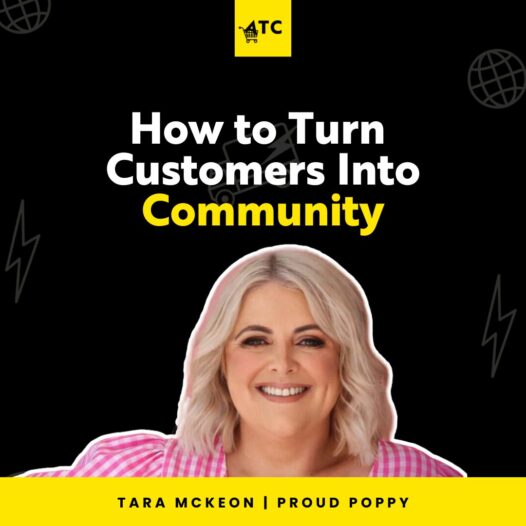
Building community before conversion: the strategy behind loyal ecommerce brands.
Everyone says they’re building a community.
But if we’re honest, most brands are actually building an audience. Followers. Email subscribers. Customers who might buy again if the timing lines up.
Community is something different. It’s when customers feel like the brand belongs to them as much as it belongs to the business itself.
That idea sits at the heart of today’s Playbook, sparked by a conversation with Tara McKeon, Founder of Proud Poppy, the size-inclusive fashion brand that has built one of the most engaged customer communities in Australian ecommerce.
Proud Poppy’s VIP Facebook group alone has more than 22,000 members, and repeat purchases outnumber single transactions.
Tara’s story, including moments where customers have told her the brand changed their lives, reveals what happens when ecommerce stops thinking about transactions and starts thinking about belonging.
Alongside Tara’s experience, lessons from Briony Kennedy from Adorn Cosmetics, Anastasia Lloyd-Wallis from Retail Doctor Group, and Laura Thompson and Sarah Sheridan from Clothing The Gaps show how some brands are turning customers into communities that drive loyalty, advocacy and growth.
You can hear Tara’s full story in her Add To Cart episode.
Build A Place To Belong
Tara McKeon didn’t just build a clothing brand with Proud Poppy.
She built a place where customers want to show up.
The Proud Poppy VIP Facebook group behaves less like a marketing channel and more like a community lounge. Customers share outfits, celebrate milestones, support each other through tough times and connect over more than just fashion.
And Tara is very deliberate about protecting that space.
She never pressures customers to buy. Instead, the focus is on connection, conversation and authenticity. Purchases happen naturally as a result of that trust, not because of sales tactics.
That approach has created something powerful: customers who feel emotionally invested in the brand. When people feel like they belong somewhere, they don’t just shop. They return, they share and they advocate.
The difference between an audience and a community is simple.
An audience listens.
A community participates.
Let Customers Lead
Briony Kennedy, founder of Adorn Cosmetics, discovered something similar when building her own customer community.
Adorn’s private Facebook group (with around 5,000 member) began as a place for beauty advice and product updates. But the real magic happened when Briony stepped back and stopped trying to control the conversation.
Customers began sharing their own makeup tips. Then life stories. Then the deeper stuff: struggles, wins, and moments where they simply needed support.
The makeup became the excuse for the gathering, not the centre of it.
Many brands treat their VIP groups like broadcast channels for launches and promotions. But Briony realised that the strongest communities form when customers start building relationships with each other.
At that point, loyalty goes beyond the product.
It becomes social.
And leaving the brand means leaving the people too.
Status Beats Savings
Loyalty programs often focus on discounts.
But Anastasia Lloyd-Wallis from Retail Doctor Group shared a fascinating insight from bubble tea brand Chatime that flips that thinking on its head.
Customers were collecting loyalty points but weren’t redeeming them.
Not because they forgot.
Because they didn’t want to.
Having the most points became a badge of honour. It showed they were the brand’s most loyal fan.
In other words, the points stopped being currency and started becoming status.
For many customers, particularly younger ones, the brands they support become part of how they signal identity. Recognition, tiers and visible loyalty can drive stronger engagement than simple discounts ever could.
If loyalty programs only reward transactions, they encourage short-term behaviour.
But when they reward belonging, they build long-term connection.
Turn Buyers Into Participants
Laura Thompson and Sarah Sheridan, founders of Clothing The Gaps, take the concept of community even further.
Their Aboriginal-led fashion brand doesn’t describe people as customers.
They call them supporters.
Every purchase is framed as participation in a bigger movement — promoting Indigenous culture, visibility and education.
That framing changes the meaning of the transaction entirely.
Instead of buying a product, customers are contributing to a shared mission.
And when people see themselves as participants rather than buyers, their behaviour shifts. They advocate more strongly, forgive mistakes more easily and actively bring others into the community.
The brands that build real community don’t treat it like a marketing tactic.
They treat it like belonging.
Tara McKeon showed how creating a space customers genuinely want to show up to can drive repeat purchases without pressure. Briony Kennedy proved that when brands step back and let customers connect with each other, loyalty deepens naturally. Anastasia Lloyd-Wallis highlighted how status and recognition can drive engagement more effectively than discounts. And Laura Thompson and Sarah Sheridan reframed the idea of a purchase as participation in a larger movement.
The thread connecting all of these stories is simple.
Word-of-mouth marketing doesn’t start with advertising.
It starts the moment customers feel like they’re part of something.
Design that feeling well, and your community won’t just support your brand.
They’ll protect it.
In this Playbook:
- How Tara McKeon built a 22,000-member community around Proud Poppy that drives repeat purchases
- Why the strongest ecommerce brands focus on community before conversion
- How letting customers lead the conversation can create deeper loyalty than any campaign
- Why status and belonging can outperform discounts in loyalty programs
- How brands like Clothing The Gaps turn customers into participants in a community-driven mission
Join Us!
Come behind the scenes with Add To Cart Community: Join our crew of ecommerce operators chasing growth, sharing wins, and staying sharp with deep dives, live events and no-BS inspiration.