Ep 631 · 17 min · Fri 5 Jun 2026

How to Run a Live Shopping Show That Actually Sells

Live shopping has been "the next big thing" in Australian ecommerce for five years now. The brands that have actually cracked it aren't on camera selling.

Play episode 631
0:00 17 min

In this episode

What Is Live Shopping in Ecommerce?

Live shopping is a real-time video format where a host or seller presents products to an audience that can buy, chat and react simultaneously. It blends entertainment with commerce, and on platforms like Whatnot, Instagram Live and TikTok, it has become a billion-dollar channel. Most Australian retailers are still treating it as a sales channel, which is exactly why it isn’t working for them. The brands that win at it treat it as a content format first.
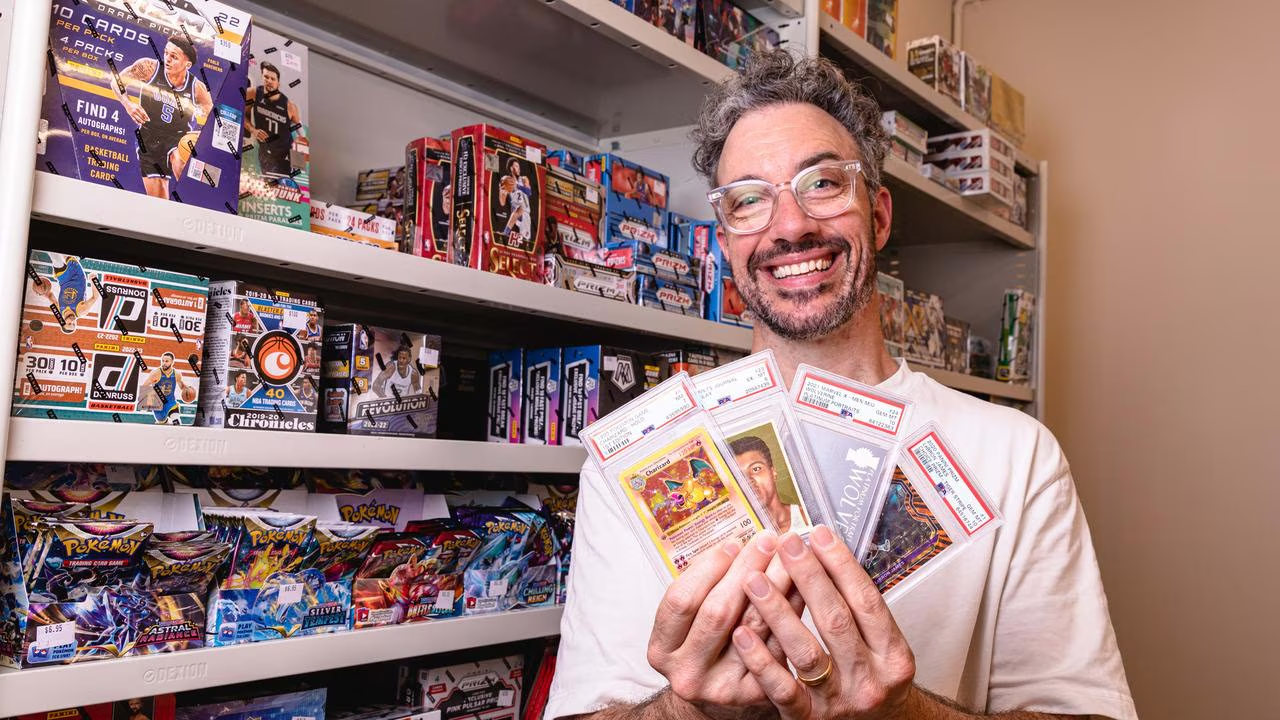

How Cherry Collectables Built a Live Shopping Community That Activated 1,600%

Cherry Collectables is Australia’s biggest trading card retailer, and Grayson White has been running live shopping there since before most operators in this country had heard the term. He started doing “breaks” (the trading card version of live shopping) back in 2008 and 2009, more than fifteen years ago. What Cherry has built since is not a sales channel. It’s a community of hundreds of thousands of collectors who trust the brand enough to move 1,600% more product on a single new release than they ever had before.

That number didn’t come from paid media. It came from fifteen years of showing up on camera, being entertaining, and giving the community something worth watching whether they were buying or not.ed on the surface.

“We’re not just trying to move them widgets for the sake of it. And they’re not going to get another email saying ‘hey, do you want more widgets?’ That’s just not how we operate.”

Live Shopping Works When Buying Is One of Three Reasons People Showed Up

The reason the breaks model caught fire and most live shopping experiments don’t comes down to who the show is built for.

Three distinct audiences turn up to every break. The collectors who want the cards. The people who want the theatre of watching a $1,000 box of cards get opened live on camera. And the people who just want to be in the chat taking the piss with everyone else. One of those three is there to transact. The other two aren’t. Design the show only for the buyers and you lose all three.

Motto Fashions, a 40-year-old Australian women’s fashion brand, proved this when COVID forced its stores to close. Lauren French and her mother started doing 4pm live streams every day, walking in barely three minutes before going live with no script. The brand grew 127% in twelve months. The streams kept running after lockdown ended because the three-audience model had taken hold. Viewers came for Lauren, for the banter, for the styling hacks. Some bought. Most just kept turning up.

The honest question for your next live show: who is turning up to watch, not just who is turning up to buy? If the only person you’re designing for is a customer with purchase intent, the show is structured wrong before it goes live.


Never Come Across as a Catalogue

Most brands approach a live show the way they’d approach a promo email. Here’s the product, here’s the price, here’s the urgency. That structure makes sense in an inbox. On a live show it kills the room. The people watching didn’t turn up for a pitch.

The trust-before-transaction model works because it changes what happens after the show. Natalie Angel, an independent fashion creator, goes live on Instagram every Friday to try on clothes and give honest fit reviews, including when something doesn’t suit a body type. No pitch. No “this looks great on everyone.” Her audience doesn’t just buy. They go back to their own networks and recommend the brands she covers. Shopify’s Hannah Yudena flagged this at the end of 2024 as the live commerce model worth paying closest attention to, because the trust the host builds is the real asset.

Grayson’s version is the same logic. Treat the community as collectors who want to escape the grind of work, focus on entertaining them first, then fold in an offer once you’ve earned the right. When the Select NRL trading cards launched, the community activated because fifteen years of not running a catalogue had earned Cherry that one moment of permission.

The ratio worth checking in your last live show: how much was entertainment versus selling? If it sat above 70% selling, the format isn’t working in your favour.


Every Show Needs an Event, Not Just a Schedule

Even Cherry is still learning the Whatnot rhythm. What separates the shows that convert from the ones that drift is that every session has an event frame, a specific reason for people to show up beyond the calendar.

Getting there requires reps you can’t fake. Oz Hair and Beauty started running live shows long before TikTok Shop arrived in Australia, deliberately, to build operational knowledge ahead of the channel. Their internet blurred mid-stream. They forgot to tell the shopping centre they were trading late, the air conditioning switched off, and their presenters were visibly sweating while trying to sell hair products. Those are the problems you only find by going live. Start before you’re ready, because the alternative is being unready when the channel matters.

When the format works, a live show becomes a content factory. The unscripted moments captured live, a world premiere, a six-figure card pull, a presenter’s honest reaction, are better raw material than anything you could storyboard. Clip them and put them everywhere.

Platform choice matters too. Whatnot works for Cherry because it’s purpose-built for event-driven commerce, with checkout sitting inside the stream itself. Trying to run live shopping on social in Australia still means navigating checkout friction that hasn’t been solved, and that conversion drop is real.

The practical check: what is the event hook for your next live show? If the honest answer is “we’re going live Tuesday at 7pm,” the show doesn’t have a reason to exist yet.


The Takeaway

The brands winning at live commerce right now aren’t standing in front of a camera talking about products. They’ve built a show people want to watch, earned enough trust to fold in an offer when it matters, and structured every session around something worth showing up for. None of that takes a broadcast budget. It takes a different way of thinking about what live commerce is actually for.

If your last live show pulled views but barely any sales, the diagnostic isn’t the discount or the platform. It’s the show itself. So who would turn up to watch yours if there was nothing to buy?


Frequently Asked Questions

Why does live shopping work for some brands and not others? Most live shopping fails because brands treat it as a sales channel rather than a content format. The brands that succeed build a show people want to watch first, then fold in offers once they’ve earned the right. The audience that shows up to a working live show is mixed: some are there to buy, others are there for the theatre or the community chat. If the show only serves the buyer, the other two groups don’t show up and the audience doesn’t grow.

What is Whatnot and why is it different from Instagram or TikTok Live? Whatnot is a purpose-built live shopping platform launched in Australia in 2024 and now operating as a multi-billion-dollar business globally. Unlike Instagram or TikTok Live, Whatnot has checkout built directly into the stream, which removes the conversion friction that has slowed social commerce in Australia. It is particularly strong for collectibles, fashion, sneakers and other category-specific commerce.

How do you structure a live shopping show that actually converts? Three things separate the shows that convert from those that don’t. First, design the show for at least three audiences: buyers, viewers who want entertainment, and the community chat. Second, never come across as a catalogue: focus on entertaining first and fold offers in once trust is earned. Third, give every show a specific event hook so it has a reason to exist beyond the schedule. A “world premiere” or a major drop performs significantly better than a routine weekly slot.

Should Australian ecommerce brands invest in live shopping in 2026? Yes, with the caveat that live shopping rewards reps. The Australian brands pulling ahead started running shows before the channel was proven, accepted operational surprises (internet drops, presenter mistakes, venue issues) as part of the cost of learning, and treated the early sessions as practice rather than revenue. Starting now means being ready when the channel matures, rather than starting from zero when competitors already have audiences.


In this Playbook:

  • Live shopping works when buying is one of three reasons people showed up
  • Never come across as a catalogue
  • Every show needs an event, not just a schedule

Read the full transcript Auto-generated

[Ad]: Did you know that retailers who are offering fast delivery outperform their competitors by 4% during Black Friday? And that's not just a stat, that's a signal for where growth is going to come from. Shipit's Commerce Delivery report breaks down why speed equals success as well as the other forces shaping delivery in 2026. From automation and AI to fulfillment and inventory, this report offers a really practical roadmap for the next phase of retail growth. If you want all the stats and the directions for what is coming in fulfillment, make sure you download this report@shipit.com CDR2026 that's shipit.com CDR2026 live shopping hey, it's been kicking around for a long time and has been the next big thing in e commerce for about five years now. And it was the next big thing when Instagram was about to roll out native commerce. It was the next big thing when TikTok shop arrived in some countries and not others. It was the next big thing when whatnot launched. And most of the brands I speak to are still watching it from the sideline, waiting to see if it's going to stick before they commit to it. The hesitation. It's understandable. Most of the live shopping experiments I've seen brands run follow the same pattern. They go live, they introduce a few products, they discount something to drive urgency, get some views, but almost no sales. And then they call it unproven. It kind of sits in the corner waiting for it to take off again. Grayson White has been running live shopping at Cherry Collectibles since before most Australian brands even heard the term. He started doing Breaks, which is the trading card version of live shopping, way back in 2008. Cherry is now Australia's biggest trading card retailer and what Grayson has built over 15 years isn't a sales channel. It's a community and an entertainment channel of hundreds of thousands of collectors who trust the brand enough to move 6 1600% more product on a single new release than they've ever had before. And that result didn't come from paid media. They didn't put it through Meta. It was 15 years of showing up on camera and giving people something they cared about and something worth watching. Then the sale came. Let's hear it from Grayson.

Nathan Bush: I really want to talk about live shopping, but before we get to that, tell me about breaks. I educated myself a little bit in breaks coming from the non card collector world. Discovery breaks and discovering how big they are and how much of an event it is. I just Had a thousand ideas of how we could potentially take this out of just cards and apply it to a broader retailer. E commerce sense.

[Ad]: But to start with, can you just

Nathan Bush: explain the concept of breaks and how you bring your community together over them?

Grayson White: Yeah, well, historically, they've always been called breaks. We've shifted to calling them live shopping to sort of align more with the modern terminology that the wider community's probably beginning to get familiar with. But essentially they began around 2008, 2009, when there were products in the marketplace that were too expensive to justify one person buying them, or they certainly weren't selling through with any velocity with one person buying them. And as such, people started to see good value in taking a $1,000 item and dividing it by the 30 possible teams. So you might buy the Los Angeles Lakers because you collect Los Angeles, and I buy the Chicago Bulls because I like Derrick Rose. And then in that product, when it gets open live on camera to a community of people that are chatting and familiar with each other and taking the piss out of each other, then you would get any of the Lakers cards that came out, and I would get any of the Chicago Bulls cards that came out, and if there were no Lakers cards, you get nothing. And it just.

[Ad]: It caught fire.

Grayson White: People that wanted the cards loved it. People that wanted the theater loved it. People that wanted to just talk shit loved it. It was a beautiful community. A really fun time in my life where how I kind of saw the future of trading cards being this really kind of live IRL experience was realized. And, you know, I love my staff. I've got an incredible team. I'm so extraordinarily lucky. But there's something beautiful as well about every single cent being yours and every decision being yours, and every mistake being yours, too, because you make a lot of those. So that was a really beautiful time. And breaks or live shopping just grew and grew and grew, and now there's so many different ways to do it. And just recently, obviously, whatnot, which is, yeah, I think like a 12 billion company now.

Nathan Bush: Huge.

[Ad]: There's not that many in Australia using

Nathan Bush: it, though, is there?

Grayson White: There's a fair few now. Only launched a year ago, Alibaba is the world's largest live shopping.

Nathan Bush: Yep.

Grayson White: But it's. Alibaba is kind of like the dfo. Whatnot is like your specific. It's like you're going there for collectibles, whether that's collectible clothes or collectible toys or cards. It's a very specialized store, and it

[Ad]: is built for performance.

Grayson White: It just Works, Yeah, it is going to make, I'm not too sure what the average age is of your listeners, but for the ones that are under 20, I think it's going to make a lot of them millionaires. It's not playing around, it does the work and you just need to find what the, what the product is that you drop in. And whether that's you collected Lego, you're going to put minifigures on it or you know, you collected DVDs and you're going to, you know, put those on there or whatever clothes you collect band T shirts, you found a place you can buy those out of Japan like boom, boom, boom. And yeah, you got to have seriously good results.

Nathan Bush: And so obviously very different mindset from E Comm where you can list your products up and hope they sell and once the inventory hits zero, your job's done. On live shopping, how do you approach that from even a scheduling or a planning perspective? Do you consider it kind of like episodes or shows or do you just kind of go events? Like how do you kind of think about that differently to kind of build hype for these events on whatnot?

Grayson White: Yeah, well, to answer your question either, but you know, not well, we're at a point where we are a slow moving ship compared to, you know, kids are hopping on that platform and they're just dominating it from the moment they hop on. We got to go through the whole process of creating a strategic objective, you know, getting the people behind that, not over burdening the people that are already in that space. Like there's a whole process that is involved in developing something like that. And there's certainly people out there that are doing phenomenally. They should be events. Every show should have an event, a really clear call to action to them. And to an extent, extent, we're getting better at that. My team are extraordinarily good at YouTube, which is where we kind of made our money and our community, that's where they live. And bringing those into that whatnot environment is something that we're learning every day and we're getting better at and we're investing in. But like you say the moment, it's like walking into a shopping center and what you need to do is have a really nice storefront and there's a

Nathan Bush: real skill, isn't there, to being a TVSN type personality in the modern world compared to being a content creator or an influencer. Influencer where you can go back and edit your stuff like to keep people entertained constantly and to fold in product and Sales messages at the same time as keeping it entertaining. What have you learned around live shopping, especially through all your events, to make it not only entertaining, but to actually

[Ad]: move product at the same time?

Grayson White: Yeah, well, that's really something that's difficult and you need to work with it delicately. Our marketing approach has always been that we've never wanted to come across as a catalog. We treat our community as an engaged and a group of collectors who want to escape the grind of whatever they're doing for work and be able to still take part, whether or not they want to be the person who's just making jokes in the stream or they want to be the person who just observes what people get. And so we freely focus on that. And then every now and then we've got an offer we'll fold in an offer for them that we think is something that is either going to be a good value to them or something that's going to be really interesting for everyone who's watching. And I think that when you've got that trust, they will activate.

[Ad]: Yep.

Grayson White: So, for example, today the Select NRL trading cards launch. When we do put up a post or we do put up a show and we say, hey, guys, world premiere of Select NRL trading cards, we find that our community go, they trust us that we're not just, you know, trying to move them widgets for the sake of moving them widgets. And they're not going to get another email that says, hey, do you want more widgets? Like, that's just not how we operate.

[Ad]: What Cherry built here isn't a sales channel. You can't compare it to the E Commerce channel or Amazon. They've actually built a model for how entertainment and commerce work together and it transfers well beyond trading cards. I mean, trading cards are cool, but I'm sure we can all think of ways that we can use live shopping in our business. So here's a few lessons. Number one, live shopping works when buying is one of the reasons that people turn up. Sounds obvious, right? But the reason that the brakes model caught fire and most live shopping experiments don't comes down to who the show is built for. Grayson says there are three distinct audiences that turn up to every card break. There are the collectors who want the cards, the people that just want the theatre, and the people that just want to turn up to be part of the conversation. One of those three is there to transact. I know that sounds grim, but one of those three is there to transact. The other two aren't. The other two are there for entertainment. And if you design the show only for those groups that are there for entertainment, you lose the whole point of the thing. Motto Fashions is a 40 year old Australian women's fashion brand and they proved this when Covid forced their stores to close. Lauren French and her mother, the brand's designers, started doing daily live streams on Instagram at 4pm and here's the interesting bit. They were walking in three minutes before going live each day with barely a script. It was pretty raw, but the brand grew 127% in 12 months during COVID I mean, we're all growing in Covid. But they put live streaming down to a lot of their success. They kept the streams running after lockdown because the three audience model had taken hold. Viewers came for Lauren, for the banter, and for the style hacks some of them were buying. The practical question for your next live show, who is turning up to watch and who is turning up to buy? If you are only designing for the customer with purchase intent or you're only showing up for the customer who's there for a little bit of entertainment, you're already structuring the whole show wrong. You need a mixture of both. Lesson 2 Don't use live shopping as a catalog Most brands approach a live show the same way that they'd approach a promotional email. Here's the product, here's the price, here's the reason to buy. Now that structure makes complete sense in an inbox where we're trying to get to the point really quickly, but on a live show it just kills the vibe. The people watching didn't turn up to be sold to. They turned up for something to watch. They could be watching a thousand other things. They chose to watch you, so you need a trust before transaction model because it changes what happens after the show. Natalie angel is an independent fashion creator who goes live on Instagram every Friday to try on clothes and give honest, real time fit reviews, including when something doesn't work for a body type or height. There's no pitch. No, this looks great on everyone. The result isn't just purchases during the show. Her audience goes back to their own networks and recommends. It keeps people coming back and coming in to the live show. This honest review builds advocates and not just customers. And that's where we need to come through first. How do we attract people into our content? How do we get them to trust us and then subtly give them something to buy if they love what we're doing? The approach at Cherry follows the same logic. Treat the community as collectors who want to escape the grind, who want a little bit of nostalgia, Focus on that first and then fold in the offer once you've earned the right to when the Select NRL cards launched, Grayson's community were activated because he had 15 years of running live shopping, not just a catalog. And they knew that Cherry had something interesting to say, that he wasn't just trying to move packets of something new. And so we need to check that for our live show. How much are we building out? That is entertainment versus how much are we selling? And do we have an entertaining idea in there? We should be leading with that. Lesson 3 Every show needs an event, not just a schedule. Even Cherry is still learning the whatnot rhythm. What separates the shows that work is that everyone should have an event frame. It's a clear reason beyond the schedule for people to show up. You need to build a bit of hype, a little bit of interest. What is different this time? But getting there requires some reps. Ozhair and Beauty started running live shows to build operational knowledge before TikTok shop arrives in Australia. But they're not doing it for the immediate revenue. When they first got up and running, their Internet blurred midstream. They forgot to tell the shopping center that they were trading late, the air conditioner switched off and their presenters end up visibly sweating while selling hair products. Not ideal. These are the problems you can only find by going live and you need to start before you're ready. But it doesn't mean that you can't hide behind not putting an event on. If you don't launch it as an event, you'll never find out when the format is working. A live show becomes a content factory. The authentic moments when captured live, whether they go well or not, create an event. These could be a six figure card pull, a presenter's honest reaction. These are all better as raw material rather than anything you create from scratch or try and script clip them and then put them everywhere. It doesn't mean that once they happen live they don't exist everywhere else. So you start with an event, you let the mayhem happen. Hopefully it's good mayhem and then you use that as content elsewhere. What really matters as well is platform choice because you don't go live across all platforms. Whatnot works really well for Cherry because it's purpose built for event driven commerce and is very much built around hobbies and interests. Trying to run live shopping on social in Australia still means navigating checkouts and a checkout friction that hasn't been properly solved. Despite all the promises and There will be a conversion drop off there. But if you're a fashion brand, most of your audience is probably on Instagram, so it makes sense to do it there. You don't have to wait for the ideal platform that gives you all the live capabilities plus the checkout at once. So the practical check for this is you need an event hook for your next live show. If you get the hook right, then you can let the mayhem happen. Hopefully good mayhem, like I said. And then you've got content that you can then distribute through all your channels, post the event, and if your audience has seen the buildup to the event, that content is likely to make a lot more sense afterwards. So Live shopping is still a work in progress. No one has cracked it yet. The platforms haven't even cracked it. We've still got a lot of promises of what's to come, but the ones that are getting ahead right now aren't just showing up to camera and talking about products. They've got a show that people want to watch. They've built enough trust to fold in an offer when it matters and for it to feel authentic. And they've structured every session around an event that's worth turning up for. None of that requires a massive team or a broadcast budget. Anyone can do this. It requires a different way of thinking about what live commerce is actually for and where you turn up to do it, and how you engage your most committed communities. If you're working out where live shopping fits in your business, which platform makes sense, or how other operators are structuring their shows to actually convert, those conversations are happening right now in the Add to Cart community every day. You can join for free over on add to cart.com au that is the playbook for this week. I'll see you next Friday.

Tagged

  • Social Media and Influencer
  • Brand and Storytelling
  • Customer Experience and Retention
Add To Cart is brought to you by
Gold partners of Australia's ecommerce podcast
Primary episodes · Mondays and Wednesdays

Other episodes you might like