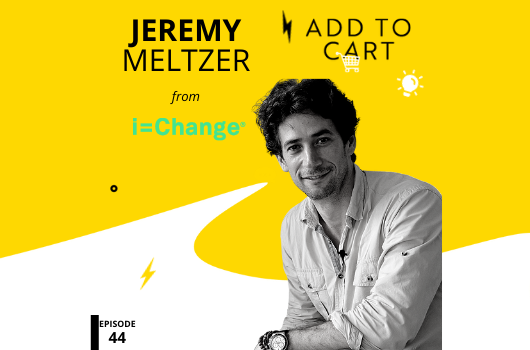
[Voiceover]: Welcome to the checkout. We catch up with previous guests of Add to Cart, where we ask them five quick questions to understand more about them and leave you with a little extra inspiration to get through your Friday. Today's checkout episode features Jeremy Meltzer from I Equal Change. Jeremy and his team at I Equal Change have raised over $2 million to help women and girls escape out of poverty, abuse and slavery. They've partnered with brands such as PE Nation, Pillow Talk and National Tiles to do so. And they're only getting started. Jeremy Meltzer from I Equal Change. We have some checkout questions for you. Number one, what is the weirdest thing you've ever bought online?
Jeremy Meltzer: It would have to be an avocado extractor, which the simple spoon wouldn't do the trick. No simple spoon, which cut my hand and then it broke. So I'm like, what a fantastic purchase. That was exciting. That was money well spent.
[Voiceover]: There you go. We live and we learn, don't we? Hopefully. It's very Melbourne of you, by the way.
Jeremy Meltzer: Oh, totally. It's all about the avocado.
[Voiceover]: Number two, this might be a hard one for you. Who is your favorite retailer?
Jeremy Meltzer: Again, back to your shirt. It would be Patagonia. I just. They've been doing this longer than almost anyone and it's just a great story in terms of their commitment. The founders built it into the brand from day one. The next favorites, all the other. I could change. Brands who are at different stages of their journeys. Whether they're doing their first sale, they're doing one sale a week, or 10,000 a week, they've decided to move forward and give back. So I think anyone who's on the journey is, to me, a rock star.
[Voiceover]: And I think that's what I love about your approach, too, is that you don't have to be perfect as long as you're on the journey and you've taken a step is a great place to be.
Jeremy Meltzer: Right. It's a really good point. You know, people say, what about supply chains and sustainability? We say, look, there's no silver bullet. This is a journey for each retailer. Right. It's not about you got to do everything perfectly before doing nothing. Because that doesn't change anything. It just creates more them. And us working with brands, taking them on the journey, looking at how they can begin to give back benefits, everyone.
[Voiceover]: Yep. It's a great perspective. Number three, which retail fad do you wish was history?
Jeremy Meltzer: Influencers. Any particular thought? I'm not going to say. I just think it's just not authentic and Customers have wisened up to it. And it's just like, you know, I often say it's like we hold our personal relationships to a very high standard of trust and authenticity. And like, if your friend lies to you or kind of tries to kind of come up with something that doesn't feel right to sell you something, they're going to pay a price, aren't they? And I just think it's the same with brands, like, where consumers are starting to expect that same level of trust, more authenticity from the brands that they want to love that they would from their friends. And so for the brands to sort of rise up and reach customers at that level and speak to them as if they would their family and friends, I think is a whole new level of sort of authentic engagement, which is a huge opportunity for brands. And that doesn't include influencers.
[Voiceover]: Is there any concept of that influencers within the social giving landscape? Has that ever been a marketing tool by some of the NGOs that you work with?
Jeremy Meltzer: No, not really. The retailers sometimes have engaged influencers, like C. Foley saw a 66% increase in engagement when giving their influencers content about their giving. So that sort of worked in an interesting way because their influencers got really excited that they could they. That they were able to talk about modern swimsuits and bikinis and talk about how those bikinis were helping give back to women and girls. So. Or the environment or, you know, whichever project three that they had chosen. So that kind of unlocked that power of the influencer world. But I think it does ultimately make a bigger point that even the influencers themselves wanted to have a more authentic conversation with their followers, which was around, in that case, seefully giving back. So it kind of comes back to the same point.
[Voiceover]: Yeah, absolutely. Number four, can you recommend a book or a podcast that our listeners should immediately get into?
Jeremy Meltzer: Yeah. So I listened to one recently. It's called Starting Greatness, and it's by Mike Maples Jr. And no guess, he's American. He is a founder of a VC firm, and he has a very interesting perspective. He talks about thinking from first principles, which is what Elon Musk does. He talks about reimagining the world that we consider normal. He talks about the fact that we think reality happens to us and we just have to do our best. We're actually. We create our world every day with our thoughts and our actions. And Steve Jobs knew that profoundly. And so he talks about shaping your world as a function of actually living in the future. So even though we're told to live in the present. He explains really articulately around how do we live in the future and then reverse engineer the past to catch up with the future. Interesting stuff.
[Voiceover]: That's brilliant. So it's about the story you tell yourself?
Jeremy Meltzer: Yeah, totally brilliant.
[Voiceover]: Finish this sentence. The future of retail is
Jeremy Meltzer: product and purpose and giving back from every sale and communicating that and engaging with your customers around both the beautiful products you create and the impact you're having on people and planet with every sale. Brilliant.
[Voiceover]: Jeremy, thank you very much for joining us.
Jeremy Meltzer: My pleasure, Nathan. Thanks mate. Thank you so much for having me. It's been really great
[Voiceover]: to hear more from Jeremy. Jump back into episode 44 where Jeremy tells us about his time in South America where he first saw the problem that he knew he had to solve. He also gives us insight into the conversion uplift his retailers are seeing from having social giving within their checkouts. And he also shares why he does new business calls on a Sunday morning for the ultimate cut through. Thanks for listening and until next time, keep adding to cart.