[Voiceover]: Welcome to the checkout. We catch up with previous add to cart guests and ask them five quick questions to get to know them better and leave you with a little extra inspiration to get through your Friday. Here's your host, Bushy.
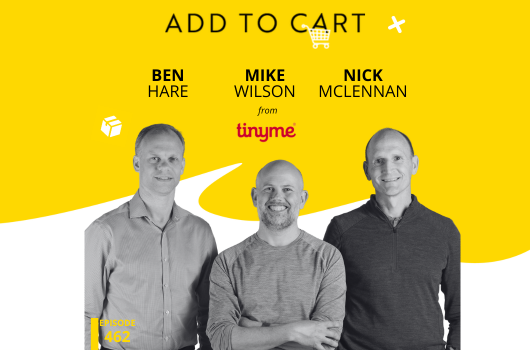
Nathan Bush: Today's checkout features Ben Hare, Mike Wilson and Nick McLennan. Yes, a three way checkout. The powerhouse team behind Tiny Me. TinyMe is the personalized kids brand that makes a huge splash in the mass customization space. In this quick fire chat, the trio of directors reveal a few quirky buyers, their unusual business inspiration. Spoiler alert. Involves rockets and some surprising hacks that help keep Tiny Me's customization empire running very, very smoothly. They are one of the best process driven retailers that that I know. Here's what they had to say. Nick, Mike and Ben, welcome to the checkout. Thank you for joining us. Here we have heard the amazing story of TinyMe. How the three of you have stuck together for 18 years now to build a mass customization for kids products and some of the fascinating things that we went into around your international expansion. Some of the systems that you're using to create such a unique offering and how you guys have created such a culture of innovation and I guess, honesty within your organization, which was fantastic to hear about. But I've got five quick questions to learn more about you guys as individuals. So number one, what is the weirdest thing that you've bought online? I'll start with you, Nick.
Nick McLennan: Not very weird, actually. I still have a very strong memory of the first thing I ever bought on ebay, which was this really cool pen. And when you rotated it and clicked it, a different color came out. I bought it internationally and paid way too much money and learned for the first time ever what, what it costs to transfer US Dollars to Australian dollars. And this was many years ago anyway, and then a couple of months later that cost me a lot of money. And a couple of months later, my brother showed me this thing that he'd been given for free with his name printed on the side that did exactly the same thing.
Nathan Bush: Probably cost $4, but it ignited a world of imagination for you.
Nick McLennan: Well, I never made that mistake on ebay ever again. That's, that's what I did.
Nathan Bush: What about you, Mike? Weirdest thing.
[Voiceover]: I've got a pretty nice ghillie suit at home. You know those ones where it's just completely.
Nick McLennan: You look like a piece of jungle.
[Voiceover]: You look like a piece of jungle. And it's the full head to toe jungle look. And I think it's four bucks in team and I thought, oh, that looks pretty cool. And so I pretty much use it to jump out of the bushes at my kids so fast. It's been very useful.
Nathan Bush: But as long as they're your kids that you're jumping out at, then we're okay.
[Voiceover]: Right, well that's right. Yeah. We'll have a dress up day. That's going to sum it because we do lots of dress up days at work and I reckon I'll get it out this year. Normally the mullet wig comes out for everything because that pretty much fits into every dress up I find.
Ben Hare: But they could go together.
Nathan Bush: Yeah.
[Voiceover]: Ghillie soup with the mullet weekend.
Ben Hare: I love it.
Nathan Bush: Oh, great one Ben, weirdest thing is
Ben Hare: probably brine shrimp eggs. Oh, is that weird enough?
[Voiceover]: Yeah, that's weird enough.
Ben Hare: Yeah.
Nathan Bush: What do you use them for?
Ben Hare: Well, you hatch them and you feed. Then you feed the brine shrimp to fish. So I keep fish. So. So it's probably. If you're a fish keeper, it's probably not weird. But for everyone else it probably sounds quite weird.
Nathan Bush: Yeah, sounds weird until you know what they're used for. But there you go. Well, it's the first time we've had that answer, put it that way. Number two, which retailer has most inspired you recently? You can answer collectively or individually. Up to you. Mike, I'm going to start with you.
[Voiceover]: Yeah. I'm a big fan of Bellroy. The bags and the. Just great execution. I merge great execution on products because I buy the product. So yeah. Just often the way they tell the stories behind the products. Yeah, that's a good one.
Nathan Bush: So yeah, it's a beautiful one. Their products last forever.
[Voiceover]: Yep.
Nathan Bush: Nick, you go.
Ben Hare: Yeah.
Nick McLennan: I mean I've said to Ben before, I'm going to say SpaceX and I tried to convince him that they're a retailer and he said nah, they're not a retailer.
Ben Hare: Yeah.
Nick McLennan: So you know, I'm, I'm up late at night, like middle of the night with my kids watching the starship launch.
[Voiceover]: After he sent the Slack message, the entire business saying, you can come to my house at 2 in the morning to watch it.
Nick McLennan: Yeah.
Ben Hare: Yeah.
Nick McLennan: So no, very, very inspired by their. Actually it's a lot of it is to do with their manufacturing methodologies and design. Design for process. It's really not.
Nathan Bush: Yeah, but it's interesting. I'm here for it.
[Voiceover]: Three child payload on rockets. We are pretty keen to start sending bags up into space. Maybe they'll.
Nathan Bush: That will.
Ben Hare: Okay.
Nick McLennan: Personalized spaces.
Nathan Bush: Yeah, there you go. That's A good one.
Ben Hare: So you are going to go to SpaceX?
Nathan Bush: I'm letting SpaceX go. I like this example. I'm here for it.
Ben Hare: I struggle with this question because I tend to get inspired by elements of different retailers rather than one as a whole. And, and I often get inspired more by people as well. But probably I find ones like Bird's Nest inspiring. Just their relentless kind of focus on the customer and continually just looking at that sort of service orienting to the customer. And then also, but also ones like Amazon I find pretty inspiring in terms of just that frictionless experience and fast, fast fulfillment. Trying to continually kind of innovate on that front, I think is pretty inspiring. Some other things aren't as inspiring about Amazon.
Nathan Bush: I mean, I love those examples because if you kind of put SpaceX, bellroy, bird's nest together, you kind of go, oh, that's kind of like tiny me territory. Like a bit of a mixture of the science and the art and the smarts all together and the customer.
Nick McLennan: That makes sense.
Nathan Bush: So I can see all that coming together. All right, number three, name a piece of tech that you or your business couldn't live without. Ben, I'm going to start with you.
Ben Hare: The obvious one for me is probably not a great one for the podcast, which is our internal production system, because we've built some pretty awesome tech and we can't live without it. And it's, it's really quite cool, like, anyway, I can't really talk about how cool it is, but apart from that there's so many things like we're a tech business, so. And all the parts of the stack really matter. So whether it's AWS or Adobe E Commerce, you know, they're fundamental things we couldn't live without. They're not necessarily always the sexiest part
[Voiceover]: of the business, but Empowerment Gateway is kind of handy.
Nick McLennan: Yeah, I thought Ben was going to say Microsoft Excel
[Voiceover]: sheets.
Ben Hare: It's all right. So yeah, I could live for like, I reckon almost two hours without that.
[Voiceover]: Yeah. There's some slightly more cynical ones like Apartment Gateway, because if it's, if it's when I'm taking any money, but ones that I enjoy using, I do like Looker Studio, just because it's free and we've just generally been a pump out. It's easy to be a developer to use it, so the marketing team uses it, I can use it. And if we need it get really tricky. The devs can get involved linking it to all the different data sources. That's been a pretty bit of a Staple for probably five years.
Nathan Bush: Yeah. Good example.
Nick McLennan: The only examples I can think of.
Ben Hare: It's got to be home assistant, isn't it?
Nick McLennan: Yeah, that's. That's probably one of my big ones. And I use it at home and at work quite a lot. So that's sort of an Iot home automation service system. And we use it an awful lot. It's. Yeah. So at home and at work, but at work it's. We definitely can't do without it now. It's great.
Nathan Bush: What's your favorite home automation that you've got set up? Is there something that's just impressive?
[Voiceover]: It's a super geeky house. It's. It's awesome.
Nick McLennan: Yeah, it's my. My favorite home automation system. I've got lots of things.
[Voiceover]: How do I love thee?
Nathan Bush: Let me count thy ways, Nathan.
Nick McLennan: So at the moment, I am working on individually controlling all the zones in the house, in the air conditioning system and to make them change relative to solar power generation and things like that.
Nathan Bush: So. Yeah.
Nick McLennan: And blinds that open and close depending on which direction the sun is in and what angle it's on at certain times of the year. So that.
Nathan Bush: It. Stuff like that.
Ben Hare: Like, my kids come around to Nick's house and it's kind of like they'll be on the apps trying to turn the lights on. It's like, how about a switch the old way?
Nathan Bush: You watch. Soon you're going to be catching rockets in your backyard. That's right. Yeah. I love it. I love it. All right, number four. Can you recommend a book or a podcast that our listeners should immediately get into? Nick, I'll start with you.
Nick McLennan: Well, probably one of my favorite books is a very old one, and most people have probably heard of it. If not read it. It's just the goal. I don't know if you ever heard of the book called the Goal by an Israeli physicist called Eli Goldratt, and it sold millions of copies. And it's all about the theory of constraints, and it's verging on mandatory reading for us when we have new staff. Most of them read that book. Yeah, it's excellent.
Nathan Bush: That's a great recommendation. Thank you.
Nick McLennan: There's a novel that explains a theory, so it's really. It's very hard to put down and not just finish it.
Nathan Bush: It's a good book. Cool.
Nick McLennan: Okay, good.
Nathan Bush: Adding that to the list.
[Voiceover]: Yeah. We've got a few other men. Not mandatory one. We actually do get everyone to read David Allen's Getting Things done when they start Copy. It's the getting Things done system. Not the greatest reader must say. Like, it takes a long time to tell you how to get things done, but all right.
Nathan Bush: So ironically, getting things done after you read this.
Ben Hare: It's a good system.
[Voiceover]: Yeah, it is a good system. Grab by choice and had like some of the. All the Jim Collins stuff actually pretty massive influence on our business. So. So, yeah, good to grade how the Mighty Falls. So I probably reread or listen to them every five or so years. I read it an awful lot. Podcasts I've sort of consistently listened to, like, how I built this. Like, I quite like that, you know, that sort of flavor. Any of the business sort of podcast. Pretty broad appetite for podcasts. But on the business side, that's been a staple with my kids. Love that one. So.
Nathan Bush: Oh, that's cool.
[Voiceover]: Yeah, love it.
Nathan Bush: Awesome. Ben?
Ben Hare: Well, pretty much all of those. We tend to read the same stuff because if anything's really interesting, we pass it on.
Nathan Bush: So I thought you would just type with the book budget, so you have to share them around.
Ben Hare: Yeah, we do. The Torino Library. We have a library here. Yeah, we do have a library, but. Yeah, so. So I could keep going down list because there's lots more. But they're probably the best ones I've read.
Nick McLennan: I've read some of those books by Osmosis. I actually haven't read them, but I
Nathan Bush: know what they're all about. You know what? That shortening service you've got built into your organization. Just the way people talk about it. So everyone feels I've read it without actually reading it.
Ben Hare: Nick loves our shortening service, the Blinkist.
[Voiceover]: Yeah, yeah.
Nathan Bush: All right, last question I have for you gents. What is your biggest challenge today? Mike, I'll start with you in the middle.
[Voiceover]: Yeah, I think one of the ones we sort of mentioned it earlier is keeping up to date with what's going on. Broadly speaking, marketing. Because it's not just keeping up to date, it's actually, how's it actually going to apply in our business? So. And it's just. It's just moving so fast. There's so many different things happening. So that's one of our biggest challenges. Look, we've got a, you know, a plan to try and tackle that, but it is. It is a big challenge. Yeah.
Nathan Bush: You've obviously done a great job to go through all the cycles over 18 years to still be growing.
[Voiceover]: Yep, absolutely.
Ben Hare: We don't do many print ads anymore.
[Voiceover]: No.
Nathan Bush: What about you, Ben? Your biggest challenge?
Ben Hare: Well, we share our biggest challenge. Like we kind of part of the same business but the. Yeah, I mean I think that's probably one of the things we're focusing on. Particularly with you always go through cycles where different marketing channels get more expensive and other ones are cropping up and you've got to keep reinventing. So I think that's continually. Well, at the moment that's probably our biggest challenge. But I mean for us also just always continue to innovate with our mass customization sort of platform. We just got to keep doing that. But it doesn't feel like a biggest challenge in one sense because we kind of love that stuff and we just keep doing it.
[Voiceover]: That's our biggest opportunity.
Nathan Bush: Depends on the mood for the day. What about you, Nick? What about the two guys taking the piss out of your home automations? Is that your biggest challenge?
Nick McLennan: Yeah, no, it's not the biggest challenge. I mean, biggest challenge today, just thinking about I've got to cook about 20 pizzas tonight, but I think that's probably not today that you're talking about. Well, this sounds like a bit of a cop out answer but it's. But it actually is something that I find difficult and that is knowing what to say no to, you know, in terms of ideas and like I'm constantly thinking of. And this is one of the reasons why my home automation is absolutely a hobby. It is not for any game that is going to be quantified economically or anything like that because unless you don't count time, of course, it's a bit of a release for me to do some stuff that wastes time at home so that I don't do so much of that at work. Heaps of ideas about ways that we can improve stuff, but just trying to pick and choose the right ones that are actually going to bring the good return for the business and that goes for improvements, but also product and marketing and all that sort of stuff. That's what everyone's trying to do.
Nathan Bush: Love it. Great challenges or opportunities whichever way you look at it. Nick, Mike, Ben, thank you for joining us on the checkout. Thank you. To hear more insights from Ben, Mike and Nick and to hear how they've built a mass customisation kids brand that has now expanded into the uk. Head back to our main episode where they share the story of TinyMe's rise from a spare room side project to being a leader in personalized kids products. We hear their strategies for global expansion, their techniques for continually improving internal processes and their unique team culture that's kept them ahead in the customisation game. Thanks for listening and until Next time, keep adding to cartoon.